The King and the Eclipse


Historian Flavius Josephus wrote that Herod died between a lunar eclipse and a Jewish Passover. Gospels Matthew and Luke report that King Herod was alive when Jesus of Nazareth was born in Bethlehem

Identifying the end of King Herod’s life would determine the birth year of Jesus of Nazareth. While some consider this information trivial, others find it important.

Without formal or reliable Western calendars, establishing the date of Herod’s death requires piecing together such clues as the reigns of Tiberius, and his sons; the Battle of Actium; the Jewish religious calendar; astronomy data; history accounts; etc.[1]

Herod was officially designated by Caesar Augustus as King, then sanctioned by the Roman Senate to rule Judea. According to Josephus, King Herod ruled for 37 years until his death that occurred between these bookend events:

“But Herod deprived this Matthias of the high priesthood, and burnt the other Matthias, who had raised a sedition with his companions, alive. And that very night, there was an eclipse of the moon.”[2]

“…and when the public morning for the king was over…at the feast of unleavened bread, which was now at hand, and is by the Jews called the Passover…” – Antiquities[3]

Lunar factual data is obtained via the science of astronomy provided by NASA and the Jewish Passover which always occurs with the first full moon of the year. Determining the actual year of Herod’s death is dependent upon both a lunar eclipse and another factor, the rule of Philip, Herod’s son.

Philip was awarded a tetrarchy by Caesar Augustus as part of the inheritance of King Herod.[4] According to the Gutenberg-printed Antiquities, Philip ruled for 37 years when he died in “the twentieth year of the reign of Tiberius”(Herod in the excerpt is Herod Antipas):[5]

“…Philip, Herod’s brother, departed this life, in the twentieth year of the reign of Tiberius after he had been tetrarch of Trachonitis, and Gaulonitis, and of the nation of Bataneana also thirty-seven years.” – Josephus (*printed)

An important factor in the 4 BC timeline date for historians is a lunar eclipse. NASA’s astronomy lunar eclipse data for Jerusalem confirms a partial eclipse with less-than-half coverage lunar occurred on March 13, 4 BC, between 1:32 am and 3:50 AM and the following Passover fell on April 10th.[6]

Thus, secular history marks Herod’s death in 3 BC strongly supported by this lunar eclipse in 4 BC. It seems relatively simple – from Tiberius’s twentieth year of rule (14 + 20), subtract the 37 years of Philips rule and it lands in 3 BC.[7]

Aside from the partial lunar eclipse in 4 BC, finding other known secular historical events corroborating this timeline has proven to be challenging. Examples: Caesar Augustus taking a census and Quirinius governing in Syria in 4 BC.[8]

NASA’s astronomy data provides a game-changing fact. January 9, 1 BC, a full lunar eclipse over Jerusalem began at 10:22 PM spanning to 3:53 AM, January 10. Passover in 1 BC was observed on April 6, twelve and half weeks later.[9]

Josephus described in detail events that transpired between the lunar eclipse and the Passover, especially after the King’s death. The question is whether all the events described by Josephus could have taken place in four weeks between the Kings death and the Passover or if 12 ½ weeks is more realistic.

When word of the King’s death reached abroad, many traveled to Herod’s funeral in Jericho from throughout Judea and from other countries that included foreign dignitaries and militaries. The following funeral procession lasted for many days to Herod’s final resting place in Herodium 30 miles away.

One of Herod’s sons, Archelaus, extended the mourning period after his interment to seven days and then gave a feast for all the people in Judea before the upcoming Passover. When the festival occurred days later, Archelaus sailed away to Rome with his family after attempting to quell civil unrest.

Further upending the 4 BC date reckoning was Biblical hobbyist David Beyer who traveled to various libraries around the world that held older handwritten copies of Antiquities. He discovered that all handwritten copies originally stated Philip died in the 22nd year of the reign of Tiberius.[10]

Beyer’s discovery adjusts the beginning of Philip’s rule to the years of 2-1 BC and changed the calculus of the death of King Herod. The discovery also aligns with other historical information.

Agrippa was given Philip’s tetrarchy by Caligula when, logically, it is unlikely the governance tetrarchy would remain vacated for 3 years if Philip had died in 33 AD. In 36 AD, Aretas and Antipas went to war “when all of Herod’s [Antipas] army was destroyed by the treachery of some fugitives, who, though they were of the tetrarchy of Philip, joined with Aretas’s army.”[11]

Additionally, archeological, historical and astronomy records tracing to 2 BC coincide with other historical timeline events:  the Silver Anniversary of Caesar Augustus and his Pater Patriae registration decree; archeological discoveries of Quirinius governing in Syria; and the Battle of Actium marking the beginning date of Herod’s reign.[12]

A lunar eclipse is the key to both scenarios. A partial lunar eclipse in 4 BC followed by the Passover less than 4 weeks later vs. a full lunar eclipse in 1 BC with the Passover 12½ weeks later.

Did Herod die in 4 BC or 1 BC?


Updated November 21, 2025.

Creative Commons License

This work is licensed under a Creative Commons Attribution-NonCommercial-NoDerivatives 4.0 International License.

REFERENCES:

[1] Livius.org. Ed. Jona Lendering. 2017. <http://www.livius.org/he-hg/herodians/herod_the_great01.html> “The Actium Project.” New World Encyclopedia. The University of South Florida and the Greek Ministry of Culture. Dir. William M. Murray. Research Project. 1997. <http://luna.cas.usf.edu/~murray/actium/brochure.html>  Chesser, Preston. “The Battle of Actium.” Ohio State University. 2002. <http://ehistory.osu.edu/articles/battle-actium> Gertoux, Gerard. “Herod the Great and Jesus: Chronological, Historical and Archaeological Evidence.” Academia.edu. n.d. <https://www.academia.edu/2518046/ Gertoux, Gerard. “Dating the death of Herod.”2015 Academia.edu. <http://www.academia.edu/2518046/Dating_the_death_of_Herod/a> “World History 50-0 BC.”  HistoryCentral.com.  MultiEducator, Inc. n.d. <http://www.historycentral.com/dates/50bc.html> Jewish Encyclopedia. 2011. <http://www.jewishencyclopedia.com/articles/7598-herod->  “Tiberius.” Encyclopædia Britannica. 2023. <https://www.britannica.com/biography/Tiberius>  Wolfram, Chuck.  “The Herodian Dynasty.” 2004. <http://web.archive.org/web/20151013221102/http://freepages.history.rootsweb.ancestry.com/~cwolfram/herod> Martin, Ernest L. The Star of Bethlehem – The Star That Astonished the World. 2nd Ed. 2003. Chapter 13. A.S.K. (Associates for Scriptural Knowledge.  <://web.archive.org/web/20170917115234/http://www.askelm.com/star/star015.htm>  Bunson, Matthew.  Encyclopedia of the Roman Empire. “Astronomy.” 2002. <https://archive.org/details/isbn_9780816045624> San José, Juan Antonio Revilla. “On the Year of Herod’s Death.”  A partial translation from “La Fecha de Muerte de Herodes y La Estrella de Belén.” pp 14, 140.  1999.  Astrology of the New Centaurs. <http://www.expreso.co.cr/centaurs/steiner/herod.html>  “Tiberius.”BBC. 2014. <http://www.bbc.co.uk/history/historic_figures/tiberius.shtml>
[2] Josephus, Flavius. Antiquities of the Jews. Trans. and commentary. William Whitson. The Complete Works of Josephus. Book XVII, Chapter VI.4. 1850. <http://books.google.com/books?id=e0dAAAAAMAAJ&printsec=frontcover&source=gbs_ge_summary_r&cad=0#v=onepage&q&f=false>
[3] Josephus. Antiquities. Trans. and commentary. William Whitson. The Complete Works of Josephus. Book XVII, Chapter IX.3. Josephus, Flavius. Wars of the Jews. Trans. and commentary. William Whitson. The Complete Works of Josephus. Book II, Chapter I.2. 1850. <http://books.google.com/books?id=e0dAAAAAMAAJ&printsec=frontcover&source=gbs_ge_summary_r&cad=0#v=onepage&q&f=false
[4] Josephus. Antiquities. Book XVII, Chapter XI.4. Josephus. Wars. Book II, Chapter 6.3.
[5] Josephus. Antiquities. Book XVIII, Chapters IV.6. (printed copy).
[6] Espenak, Fred. “Javascript Lunar Eclipse Explorer.” NASA Eclipse Website. n.d.  Asia and Asia Minor – Jerusalem, Israel. Century Selection -0001 – 0100. <https://eclipse.gsfc.nasa.gov/JLEX/JLEX-AS.html> Total Lunar Eclipse.  Pilot&Today. image. 2014. <https://cdn.steamboatpilot.com/wp-content/uploads/sites/8/2017/06/TotalLunarEclipse_122110.jpg>
[7] Villalba i Varneda, Pere. The Historical Method of Flavius Josephus. 1986. p14, pt #8.  <http://books.google.com/books?id=kdUUAAAAIAAJ&lpg=PA14&ots=2ek7SgCy2c&dq=josephus%2C%20battle%20of%20actium%2C%20herod&pg=PA14#v=onepage&q=josephus,%20battle%20of%20actium,%20herod&f=false>  Schaff, Philip. “Chronology of the Life of Christ.” History of the Christian Church, Volume I: Apostolic Christianity. A.D. 1-100. Chapter 2. 1890.  Christian Classics Ethereal Library. 2005. <http://www.ccel.org/ccel/schaff/hcc1.i.II_1.16.html> Sieffert, F. “Census.” The New Schaff-Herzog Encyclopedia of Religious Knowledge. Vol. II:  Basilica – Chambers. 1952. <http://www.ccel.org/s/schaff/encyc/encyc02/htm/iv.vi.ccxxx.htm> “Philip the Tetrarch.” Fandom. n.d. <https://bible.fandom.com/wiki/Philip_the_Tetrarch> Bernegger, P.M. “Affirmation of Herod’s Death in 4 B.C.” Journal of Theological Studies Vol. 34, no 2, pp 526-531. 1983.  Schurer, Emil.  A History of the Jewish People in the Time of Jesus Christ. Volume 1. 1890. <http://books.google.com/books?id=BRynO3W9FPcC&pg=PP1#v=snippet&q=Tiberius&f=false>
[8] Davis, John D. “Quirinius” (Quirinus), cwui-rin’i-us, Publius Sulpicious.” The New Schaff-Herzog Encyclopedia of Religious Knowledge. Vol. IX: Petri – Reuchlin. 1953. <http://www.ccel.org/s/schaff/encyc/encyc09/htm/iv.vi.xii.htm>  Ramsay, William M.  “Was Christ Born in Bethlehem?” Chapter 11. 2010. <http://biblehub.com/library/ramsay/was_christ_born_in_bethlehem/index.html> Villalba i Varneda, Pere. The Historical Method of Flavius Josephus. The Historical Method of Flavius Josephus.” pp 15 -16, pts. 8-10.
[9] Espenak. “Javascript Lunar Eclipse Explorer.” NASA Eclipse Website. n.d.  Asia and Asia Minor – Jerusalem, Israel. Century Selection -0001 – 0100.  Unraveling the Twenty-Second Year of Tiberius.” Chronos, Kairos, Christos II.  Ed.  Jerry Vardaman. 1998. <http://books.google.com/books?id=mWnYvI5RdLMC&lpg=PP1&dq=isbn%3A0865545820&pg=PA85#v=snippet&q=beyer&f=false> Jachowski, Raymond. Academa.Edu. “The Death of Herod the Great and the Latin Josephus: Re-Examining the Twenty-Second Year of Tiberius.” n.d. <https://www.academia.edu/19833193/The_Death_of_Herod_the_Great_and_the_Latin_Josephus_Re_Examining_the_Twenty_Second_Year_of_Tiberius>
[10] Beyer, David W.  “Josephus Reexamined:  Unraveling the Twenty-Second Year of Tiberius.” Chronos, Kairos, Christos Kidger, Mark R.  “The Date of Passover 11BC – 10AD.” Mark Kidger`s Comet and Asteroid Observing Home Page. n.d. http://www.observadores-cometas.com/cometas/Star/Passover.html> “Unraveling the Twenty-Second Year of Tiberius.” Chronos, Kairos, Christos II.  Ed.  Jerry Vardaman. 1998. <http://books.google.com/books?id=mWnYvI5RdLMC&lpg=PP1&dq=isbn%3A0865545820&pg=PA85#v=snippet&q=beyer&f=false> Jachowski. Academia.Edu. “The Death of Herod the Great and the Latin Josephus:  Re-Examining the Twenty-Second Year of Tiberius.” Kidger. “The Date of Passover 11BC – 10AD.
[11] Josephus. Antiquities. Book XVII, Chapter VI.4; Book XVIII, Chapter V.1.  Josephus. Wars. Book II, Chapter IX.5.” “Herod Antipas.” Britannica Encyclopedia. 2022. <https://www.britannica.com/biography/Herod-Antipas> “Aretas.” Bible History. 2022. <https://bible-history.com/links/aretas-1067>
 “Antipas and Rome.” Bible-History. n.d. <https://bible-history.com/herod-antipas/antipas-and-rome> “Aretas.” Encyclopedia.com. n.d. <https://www.encyclopedia.com/reference/encyclopedias-almanacs-transcripts-and-maps/aretas>
[12] Gertoux, Gerard. “Dating the two Censuses of Quirinius.” 2018. Academia.edu. <http://www.academia.edu/3184175/Dating_the_two_Censuses_of_Quirinius>  Josephus. Antiquities. Book XVII. Chapter VII. Josephus. Wars. Book I, Chapter XXXIII; Book II, Chapter XIX.  “Augustus.”  UNRV History |The Roman Empire. United Nations of Roma Victrix. 2017. <http://www.unrv.com/fall-republic/augustus.php
An Unusual Roman Census Decree By Caesar Augustus


Traditional Nativity stories refer to the “census” decreed by Caesar Augustus. It was the motivation for Joseph and Mary to travel in her late eighth month of pregnancy to Bethlehem 90-miles away where Gospel Nativity accounts of Matthew and Luke report she gave birth to Jesus of Nazareth.

LK 2:1-3 “Now in those days a decree went out from Caesar Augustus, that a census be taken of all the inhabited earth. This was the first census taken while Quirinius was governor of Syria. And everyone was on his way to register for the census, each to his own city.” NASB

Derived from the Latin word censēre is the English word “census.” The word “census” is not used in many Gospel English translations and for good reason – nowhere in the original Greek texts is found the Latin word censēre.[1]

As a parallel comparison in the four works of Jewish historian Josephus, only one similar event is referenced. In Antiquities of the Jews, Moses “numbered” the Hebrew army, but Josephus didn’t use the word “census.”[2]

Only two possibilities for Greek equivalents are words apographo and apographe, each with very similar meanings.[3] One word is an activity and the other is a document record, yet both words have been interchangeably translated in English Bibles with five variations of “census,” “registered,” “enrolled,” “numbering,” and “taxed.”[4]

As a verb in Luke 2:1 and 3, apographo means an activity to “write off (a copy or list), i.e. enrollment,” an enrollment activity. As a noun in Luke 2:2 , apographe is “an enrollment, by implication an assessment,” an enrollment record.

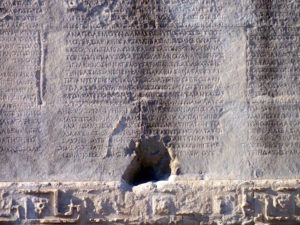
Res gestae divi Augusti

Backdrop of a Roman census is the multiple facets associated with a censēre where enumeration of Roman citizens was the prized objective. Augustus took three lustrum censuses during his 44-year reign. In Caesar’s own words:

“When I was consul the fifth time (29 B.C.E.), I increased the number of patricians by order of the people and senate. I read the roll of the senate three times, and in my sixth consulate (28 B.C.E.) I made a census of the people with Marcus Agrippa as my colleague. I conducted a lustrum, after a forty-one year gap, in which lustrum were counted 4,063,000 heads of Roman citizens. Then again, with consular imperium I conducted a lustrum alone when Gaius Censorinus and Gaius Asinius were consuls (8 B.C.E.), in which lustrum were counted 4,233,000 heads of Roman citizens. And the third time, with consular imperium, I conducted a lustrum with my son Tiberius Caesar as colleague, when Sextus Pompeius and Sextus Appuleius were consuls (14 A.C.E.), in which lustrum were counted 4,937,000 of the heads of Roman citizens.” – The Deeds of Divine Augustus [5]

Roman lustrums involved a lesser known religious component. A sacred ceremony at the conclusion of a lustrum involved the Censor offering a sacrifice to the god Mars on behalf of Rome’s citizens.[6]

Taxation comes into play because data collection from a censēre was typically used as the basis to initiate a tax valuation, an assessment or appraisal. A Roman procurator was then responsible for actual tax collection activities managed through local authorities.[7]

Publicani purchased franchise rights to collect taxes through an auction held in Rome.[8] Abuses of tax collection were rife, a natural consequence of the Roman tax collection system.

A franchise inherently involves making a profit, but Rome didn’t care about how the proceeds were collected as long as the government received its expected revenue. This opened the door to dishonest and abusive behaviors to collect more revenue than was necessary by the franchise owner’s tax collection agents known as publicans, the despised tax collectors of the Gospels such as was the Disciple Matthew.[9]

Aligning with secular historical timelines appears to pose a conflict with these two Gospels. Historians, religious scholars, and detractors take varied and opposing positions; however, virtually all believe both Herod and Augustus had to be alive when Jesus was born. The controversy surrounds the date of Herod’s death.

Luke corroborates Matthew as Herod being alive and adds two more dating parameters – the “census” and Quirinius factors.[10] According to Luke, the birth of Jesus occurred when Quirinius governed in Syria making the year 8 BC too soon under known or possible secular historical scenarios for Quirinius to be a governor.

Secular history places Herod’s death in 4 BC centered on both a lunar eclipse and reckoning from the printings of Josephus’ Antiquities. This 20th year of the reign of Tiberius is used to reckon the date Herod’s death.[11]

Major world libraries holding handwritten manuscript copies of Antiquities predating the printings were personally investigated and reviewed by historian buff David Beyer. He discovered that all 31 copies of existing handwritten manuscripts actually say Herod’s death occurred during the 22nd year of Tiberius, not the 20th year.[12]

The 2-year difference translates into Herod’s death occurring in 2 BC or early 1 BC, not 4 BC.[13] Not uncommon were errors in transcribing manuscript documents according to Westcott and Hort, experts in literary analysis. 

Dr. Earnest Martin’s research points to a special set of circumstances in 2 BC.[14] Rome was in the height of its glory commemorating the 750th anniversary of its founding and was the same year as the Silver Jubilee reign of Caesar Augustus.

Roman history records the Senate bestowed upon their emperor the honor of Pater Patriae, an honor Augustus considered to be one the highlights of his reign listed in The Deeds of Divine Augustus. Martin asserts that to underscore this honor, the Roman Senate had Augustus decree a “registration” to be taken of the entire Roman Empire claiming allegiance to him as Pater Patriae.[15]

Historian expert Gerard Gertoux conducted independent research that corroborates the findings of Beyer and Martin. Gertoux concluded that Luke’s “census of the world” occurred in 2 BC and was not for taxation purposes.

Gertoux determined that Caesar’s motivation for the “census” was to quantify the entire resources of Rome as part of his breviarium totius imperii. Eventually this was to be read at his funeral along with the unveiling of his Res gestae divi Augusti (The Deeds of Divine Augustus).[16]

Research evidence produced by Beyer, Martin and Gertoux establishes a 2 BC timeline for a special “census” registration decreed by Augustus that occurred before the death of King Herod in late 2 BC or early 1 BC. These findings are consistent with dating parameters documented in the accounts of Matthew and Luke – Herod’s reign; reign of Augustus and his census decree; governing of Quirinius in Syria plus one other dating parameter, the Star corroborated by NASA data.

Perhaps the strongest evidence of Luke’s reference of a registration decree issued by Augustus has nothing to do with history and is best presented with a question.

How likely is it that Joseph would risk taking Mary, a young almost 9-month pregnant teenage girl, away from her comfortable home and family on a difficult, treacherous week’s long journey on the back of a donkey to Bethlehem 90 miles away knowing it was quite possible that Mary could give birth in the wilderness along the way – unless the Town Crier’s announcement of Augustus’ decree gave them no other choice?[17]


Updated November 29, 2025.

Creative Commons License

This work is licensed under a Creative Commons Attribution-NonCommercial-NoDerivatives 4.0 International License.

REFERENCES:

[1] “Census.”  Merriam-Webster. 2018. <https://www.merriam-webster.com/dictionary/census
[2] Josephus, Flavius. Antiquities of the Jews. Book 3, Chapter 12.4. The Complete Works of Josephus. 1850. <http://books.google.com/books?id=e0dAAAAAMAAJ&printsec=frontcover&source=gbs_ge_summary_r&cad=0#v=onepage&q&f=false>
[3] Luke 2:1-4.  Net.bible.org. Greek text. “apographo <583>” and “aprographe <582>.” n.d. <http://lexiconcordance.com>  Smith, William; Wayte, William; Marindin, G.E., Ed. A Dictionary  of Greek and Roman Antiquities. 1890. “apographe.” <https://books.google.com/books?id=Cu89AAAAYAAJ&pg=PA403&lpg=PA403&dq=greek+word+for+census&source=bl&ots=LM1MjmCiJt&sig=1_yjJgyNxcCcSWZvf0QK69IJuMw&hl=en&sa=X&ved=0ahUKEwjx0oPA04DYAhXo6YMKHebvAEwQ6AEIejAK#v=onepage&q=register&f=false>
[4] NASV, NRSV, ASV, BBE, KJV.  Bunson, Matthew.  Encyclopedia of the Roman Empire. “Censor; Census.” <https://archive.org/details/isbn_9780816045624
[5] Augustus, Caesar.  The Deeds of the Devine Augustus (Res gestae divi Augusti). #8. Trans. Thomas Bushnell. 1998. <http://classics.mit.edu/Augustus/deeds.html>
[6] “Lustrum.” Livius.org. Ed. Jona Lendering. 2018. <http://www.livius.org/concept/lustrum>  Bunson. Encyclopedia of the Roman Empire. “Censor, Census.”
[7] Smallwood, E. Mary.  The Jews Under Roman Rule: From Pompey to Diocletian. 2nd Ed. 1981. pp 151-152. http://books.google.com/books?id=jSYbpitEjggC&lpg=PA151&ots=VWqUOinty4&dq=census%20Syria%20Rome&pg=PP1#v=onepage&q&f=false Smith, William. “Dictionary of Greek and Roman Geography.” 1901. 3rd Ed., Vol. 1. “Censor”, “Publicani” and “Vectigalia.” <https://books.google.com/books?id=Cu89AAAAYAAJ&pg=PA403&lpg=PA403&dq=greek+word+for+census&source=bl&ots=LM1MjmCiJt&sig=1_yjJgyNxcCcSWZvf0QK69IJuMw&hl=en&sa=X&ved=0ahUKEwjx0oPA04DYAhXo6YMKHebvAEwQ6AEIejAK#v=onepage&q=census&f=false “Procurator.” Livius.org. Ed. Jona Lendering. 2018. <http://www.livius.org/concept/procurator>
[8] Smallwood.  The Jews Under Roman Rule. p 152.
[9] Matthew 9; Luke 5. Smith, W. Dictionary of Greek and Roman Antiquities. “Censor.” “Publicani” and “Vectigalia.”
10] Matthew 2; Luke 1. Smallwood. The Jews Under Roman Rule. Appendix E, p 568.
[11] Josephus.  Antiquities of the Jews. Book XVIII, Chapter II. 2, VI.5.  Josephus. Wars. Book I, Chapter XXXIII.8. Chapters IV.6 and V.4.  Bernegger, P.M. “Affirmation of Herod’s Death in 4 B.C.” Journal of Theological Studies Vol. 34, no 2. 1983. pp 526-531. <http://www.redatedkings.com/postings/Bernegger.pdf>  Schurer, Emil. A History of the Jewish People in the Time of Jesus Christ. Volume 1. 1890. pp 464-465, footnote 165. <http://books.google.com/books?id=BRynO3W9FPcC&pg=PP1#v=snippet&q=Tiberius&f=false> Doig, Kenneth F.  New Testament Chronology. 1990. Chapter 4.<http://nowoezone.com/NT_Chronology.htm>  Jachowski, Raymond. Academa.Edu. “The Death of Herod the Great and the Latin Josephus: Re-Examining the Twenty-Second Year of Tiberius.” n.d. <https://www.academia.edu/19833193/The_Death_of_Herod_the_Great_and_the_Latin_Josephus_Re_Examining_the_Twenty_Second_Year_of_Tiberius
[12] Chase, Jeffrey S. “The Gutenberg Printing Press.” n.d. <http://www.cs.duke.edu/~chase/cps49s/press-summary.html>
[13] Beyer, David W. “Josephus Reexamined:  Unraveling the Twenty-Second Year of Tiberius.” pp 90-93, 95-96.  <http://books.google.com/books?id=mWnYvI5RdLMC&lpg=PP1&dq=isbn%3A0865545820&pg=PA85#v=snippet&q=beyer&f=false> Wolfram, Chuck. “The Herodian Dynasty.” 2004. <http://web.archive.org/web/20151013221102/http:/freepages.history.rootsweb.ancestry.com/~cwolfram/herod> Westcott, Brooke F. & Hort, John A. The New Testament in the Original Greek – Introduction | Appendix. pp 4-7. 1907. <https://books.google.com/books?id=gZ4HAAAAQAAJ&printsec=frontcover&dq=The+New+Testament+in+the+Original+Greek&hl=en&sa=X&ved=0ahUKEwiOjMvk3fjXAhUE5yYKHSTHC5wQ6wEIOjAD#v=onepage&q=The%20New%20Testament%20in%20the%20Original%20Greek&f=false> Martin, Ernest L. The Star of Bethlehem – The Star That Astonished the World. Chapter 13. <http://askelm.com/star/star000.htm#_edn11>  Jachowski. “The Death of Herod the Great and the Latin Josephus: Re-Examining the Twenty-Second Year of Tiberius.”
[14] Gertoux, Gerard. “Dating the two Censuses of Quirinius.”  n.d.  pp 6-7. <http://www.academia.edu/3184175/Dating_the_two_Censuses_of_Quirinius>  Stevenson, Tom R. “Acceptance of the Title Pater Patriae in 2 BC.” <https://www.academia.edu/21863060/Acceptance_of_the_Title_Pater_Patriae_in_2_BC
[15] Augustus. The Deeds of the Devine Augustus. #35.  “pater patriae.”  Nova Roma. 2017. <www.novaroma.org/nr/Pater_Patriae_(Nova_Roma)>  “pater patriae.” Encyclopædia Britannica. 2018. <https://www.britannica.com/topic/pater-patriae> Martin. The Star of Bethlehem. Chapter 13.  Mosley, John. “Common Errors in ‘Star of Bethlehem’ Planetarium Shows.” Reprint from Planetarian, Third Quarter 1981. <http://www.ips-planetarium.org/?page=a_mosley1981> Gertoux. “Dating the two Censuses of Quirinius.” p 7.
[16] Gertoux. “Dating the two Censuses of Quirinius.”  pp 6-7.  Davis, William Steams, ed.  Readings in Ancient History: Illustrative Extracts from the Sources. Vol. II: Rome and the West. 1912-13. pp. 166-172. <http://www.fordham.edu/halsall/ancient/14resgestae.asp>  Schaff, Philip. “Chronology of the Life of Christ.”  History of the Christian Church, Volume I: Apostolic Christianity. A.D. 1-100. 1890. Chapter 2, Sec 16.  <http://www.ccel.org/ccel/schaff/hcc1.i.II_1.16.html>
[17] “Distance between Nazareth and Bethlehem.” DistanceFromTo.net. 2018. <https://www.distancefromto.net/between/Nazareth/Bethlehem> “What is the distance between Nazareth and Bethlehem?” Reference.com. 2017. <https://www.reference.com/geography/distance-between-nazareth-bethlehem-6ac7e95c8360c7c7#> Bing.com/maps. Modern day mileage calculation from Bethlehem to Nablus (Nazareth) <https://binged.it/2mNpBy8>  Smallwood, E. Mary.  The Jews Under Roman Rule: From Pompey to Diocletian. p 152. 1981.<http://books.google.com/books?id=jSYbpitEjggC&lpg=PA151&ots=VWqUOinty4&dq=census%20Syria%20Rome&pg=PP1#v=onepage&q&f=false>  Tarwacka, Anna. “The consequences of avoiding census in Roman law.” 2013. <https://www.academia.edu/5525859/The_consequences_of_avoiding_census_in_Roman_law>