Rabbi Rashi and the Messiah Prophecies


Dark Ages were transitioning from rule by barbarian tribes like the Huns, Goths and Franks into the feudal era when kings, queens, knights & lords ruled Europe when Rabbi Rashi emerged.[1] Rashi is considered by Judaism to be one of the greatest interpreters of the Talmud.

In the year 1040, Shlomoh Yitzha was born in Troyes, France, and as a Rabbi, Rashi was renowned for his wisdom and interpretation of the Talmud in simple terms.[2] Jewish academies widely accepted and valued his commentaries mostly captured and documented by his students.[3]
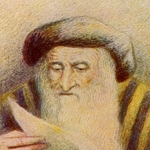
Commentaries of Rashi point to some prophecies foretelling the arrival of the Messiah. One of the earliest is found in  Jacob’s blessing of his son, Judah:

Gen 49:8-10 “Judah, [as for] you, your brothers will acknowledge you. Your hand will be at the nape of your enemies, [and] your father’s sons will prostrate themselves to you.  A cub [and] a grown lion is Judah.  From the prey, my son, you withdrew. He crouched, rested like a lion, and like a lion, who will rouse him? The scepter [shebet] shall not depart from Judah, nor the student of the law from between his feet, until Shiloh comes, and to him will be a gathering of peoples.” (The Complete Jewish Bible with Rashi Commentary)

Rashi’s interpretation of Jacob’s prophecy included three prophetic aspects:

like a lion, David would become like a lion when the people made him their king.

The scepter represents the royal lineage of “David and thereafter.”

Shiloh refers specifically to “King Messiah, to whom the kingdom belongs.”[4]

Another Messiah prophecy involved Moabite King Balak who realized his army could not defeat the Hebrew’s. His strategy, instead, was to press the prophet Balaam to place a curse on the approaching Hebrew nation, but Balaam’s response was a prophecy doing just the opposite:

Num 24:17  “I see him, but not now; I behold him, but not near; A star shall come forth from Jacob, A scepter [shebet] shall rise from Israel, And shall crush through the forehead of Moab, And tear down all the sons of Sheth.” NASB

Consistently, the Rabbi’s commentary says shebet represents “a king who rules dominantly. Hebrew word shebet is translated in the Jewish version as “staff” whereas the same word is earlier translated as “scepter” in Jacob’s blessing prophecy.[6] 

Slight interpretations variations are found on Hebrew text translations between Christian and Jewish Bibles where a word in Hebrew text must be deciphered by translators. Christian Bible translations typically read “I see him, but not now;” Jewish Bible translations read “I see it, but not now” although the context inferred by the remainder of the prophecy is about a king.[5]

Micah 5:1/2 is recognized by Rashi as a prophecy making specific reference to a future ruler of Israel who comes from Bethlehem Ephrathah, the home town of King David. Although opposed by some Jewish authorities, Rashi believed this to be a specific Messiah prophecy.[7]

Mich 5:1 (or v.2) “And you, Bethlehem Ephrathah – you should have been the lowest of the clans of Judah-from you [he] shall emerge for Me, to be a ruler over Israel; and his origin is from of old, from days of yore.” – The Complete Jewish Bible with Rashi Commentary

“And you, Bethlehem Ephrathah”:  [Rashi] “whence David emanated, as it is stated (I Sam. 17:58): “The son of your bondsman, Jesse the Bethlehemite.” And Bethlehem is called Ephrath, as it is said (Gen. 48:7): “On the road to Ephrath, that is Bethlehem.”

“you should have been the lowest of the clans of Judah”: [Rashi] You should have been the lowest of the clans of Judah because of the stigma of Ruth the Moabitess in you.

“from you shall emerge for Me”: [Rashi] the Messiah, son of David, and so Scripture says (Ps. 118:22): “The stone the builders had rejected became a cornerstone.”

“and his origin is from of old”: [Rashi] “Before the sun his name is Yinnon” (Ps. 72:17).

Commenting on “the stigma of Ruth the Moabitess,” Rashi said it is the reason Bethlehem is called “the lowest of the clans of Judah.” Expressing his distaste of Ruth, a Gentile, it was unsavory to have a Gentile in a Hebrew lineage.[8]

Ruth was the Moabite daughter-in-law of the Hebrew Naomi, whose inheritance was lost by the deaths of her sons, but redeemed by marriage to the Hebrew Boaz. As the grandparents of Jesse, they were the great grandparents of King David.

Boaz was the son of Salmon who had married Rahab, the Gentile prostitute who hid two Hebrew spies being sought by the Jericho King’s posse.[9] As a reward, Rahab was spared by the Hebrews when they destroyed Jericho.[10]

Leaving no doubt his interpretation of Micah 5:1/2 is a Messiah prophecy, Rashi explicitly said the future ruler of Israel would be “the Messiah, Son of David” referring to Psalms 118:22. The Messiah’s divine characteristic, “his origin is from of old,” is called Yinnon by Rashi, a Hebrew epithet meaning “be continued.”[11]

Zechariah 12:10 is a prophecy foretelling the Messiah’s manner of death, according to Rashi. Taking a side in the split view of Talmud contributors in Talmud Sukkah 52, he commented, “And our Sages expounded this in tractate Sukkah (52a) as referring to the Messiah, son of Joseph, who was slain.”[12]

Christianity’s agreement with Rashi on the Messiah prophecies of Jacob, Balaam, Micah and Zechariah, part company on another prophecy, Isaiah 7:14.[13] Isaiah’s prophecy, Rashi taught, was not about a virgin birth of the Messiah, rather it referred to Manoah’s wife, mother of Sampson, the Biblical strongman.[14]

As a Rabbi, Rashi obviously did not believe Jesus of Nazareth was the Messiah primarily due to a particular disqualifying reason. Specifically it was the circumstances of his death, according to JewishEncyclopedia.com citing Rashi – Jesus was hanged:

“The very form of his punishment would disprove those claims in Jewish eyes. No Messiah that Jews could recognize could suffer such a death; for “He that is hanged is accursed of God” (Deut. xxi. 23), ‘an insult to God’ (Targum, Rashi).”[15]Jewish Encyclopedia

Crucifixion of Jesus as a historical fact nor the birth of Jesus in Bethlehem in the royal lineage of the House of David are undisputed in that era by Judaism. Ultimately, the question between Christianity and Judaism remains…what are the odds Jesus of Nazareth was a fulfillment of the Messiah prophecies?


Updated July 27, 2025.

Creative Commons License
This work is licensed under a
Creative Commons Attribution-NonCommercial-NoDerivatives 4.0 International License.

REFERENCES:

[1] “Dark Ages.” New World Encyclopedia. 2013. <http://www.newworldencyclopedia.org/entry/Dark_Ages>  “Middle Ages,” “Feudalism,” & “Renaissance.”  Encyclopædia Britannica.  2017. <https://www.britannica.com/event/Middle-Ages> <https://www.britannica.com/topic/feudalism> <https://www.britannica.com/event/Renaissance>  “feudal system.” Vocabulary.com. n.d. <https://www.vocabulary.com/dictionary/feudal%20system>
[2] “Rashi (Solomon Bar Isaac).” Jewish Encyclopedia. 2011. <http://jewishencyclopedia.com/articles/12585-rashi-solomon-bar-isaac>  “Rabbi Shlomo Yitzchaki (Rashi).”  Chabad.org. 2017. <http://www.jewishvirtuallibrary.org/rabbi-shlomo-yitzchaki-rashi> Segal, Eliezer.  “Rashi’s Commentary on the Talmud.”  University of Calgary.  n.d.  <http://people.ucalgary.ca/~elsegal/TalmudMap/Rashi.html>  “RASHI – רש״י.” Geni. photo. 2022. <https://www.geni.com/people/RASHI-%D7%A8%D7%A9-%D7%99/6000000006709501378
[3] “Rabbi Shlomo Yitzchaki (Rashi).” Chabad.org.
[4] Rashi. The Compete Jewish Bible – with Rashi Commentary. Gensis 49. <http://www.chabad.org/library/bible_cdo/aid/9952#showrashi=true>  “Rashi (Rabbi Shlomo Yitzchaki).”  Jewish Virtual Library. 2017.  Mindel, Nissan. “Rabbi Shlomo Yitzchaki (Rashi).”  Chabad.org.
[5] Net.bible.org. Hebrew text. <http://classic.net.bible.org/bible.php>
[6] Net.bible.org. Hebrew text shebet <07626>  Numbers 24:17. Rashi. The Complete Jewish Bible with Rashi Commentary  Commentary.
[7]  “Jesus of Bethlehem.” MessianicJewishTruth.com. n.d. Archive.org. 2013.  <http://web.archive.org/web/20131103080951/http://www.messianicjewishtruth.com/Jesusbethlehem.html>      “Who will emerge from Bethlehem.”  Teshuvas HaMinim.  2011.  Archive.org. 2012.  <http://web.archive.org/web/20120902023316/http://www.teshuvashaminim.com/michah51.html>
[8] Mendel. “Rashi (Rabbi Shlomo Yitzchaki).”
[9] Joshua 2.
[10] Joshua 6:25; I Chronicles 2:11; Matthew 1:5.
[11] Yinon (Yinnon).” eTeacherHebrew.com.  2016. <http://eteacherhebrew.com/Hebrew-Names/yinon-yinnonInterlinear Bible.  Psalms 72:17. BibleHub.com.  2014. <http://biblehub.com/interlinear>
[12] The Compete Jewish Bible – with Rashi Commentary. Zechariah 12:10  <http://www.chabad.org/library/bible_cdo/aid/63255/jewish/The-Bible-with-Rashi.htmSoncino Babylonian Talmud. Sukkah 52a. <http://www.halakhah.com/rst/moed/16b%20-%20Succah%20-%2029b-56b.pdf>
[13] The Complete Jewish Bible with Rashi Commentary.  Isaiah , Chapter 7.  “Who is the Almah’s son?” Teshuvas HaMinim. 2011.  Archive.org.  2012.  <http://web.archive.org/web/20120425022737/http://www.teshuvashaminim.com/isaiah714.html>  Robinson, B.A. “Isaiah 7:14 “Behold, a virgin shall conceive…””  Religious Tolerance. 2007. <http://www.religioustolerance.org/chr_proi.htm>  Gill, John.  John Gill’s Exposition of the Whole Bible.  Isaiah 7:14.  2017. https://www.studylight.org/commentaries/geb.html>
[14] The Compete Jewish Bible- with Rashi Commentary.  Isaiah 7:14. CR Judges Chapter 13.
[15] “Jesus of Nazareth.”  Jewish Encyclopedia.  2011.;
 

The Place – Promises at Mt. Sinai 


Mt. Sinai, Horeb in Hebrew meaning “desert”, is the place where God gave Moses the 10 Commandments, the Law and additionally other promises. These promises and building upon another, in total five, served as the foundational building blocks for the Messiah.

Abraham, Isaac and Jacob were promised through blessings from God as the place for their descendants to possess. Additionally, at Mt. Sinai God promised to establish a kingdom; the permanent place for His Name to dwell; the exclusive place for Israel to observe the Passover; and the Judgement Seat of Israel.[1]

God did not give a lot of details for the place to the Hebrews. None of these promises, other than they would occur in the land promised to Abraham, were fully understood by the Hebrews who, after 400 years, had just fled the harsh rule of Pharaoh in Egypt, the only life they had ever known.

For a ragtag nation of tens of thousands of former slaves without an army, it seemed like an impossibility. Not fully conceptualized, great faith in these promises were required from the fledgling nation of people.

Doubts and lack of faith by the Exodus generation would cost them from seeing God’s promised land.[2] Yet against all odds, over the coming centuries, these promises became a reality.

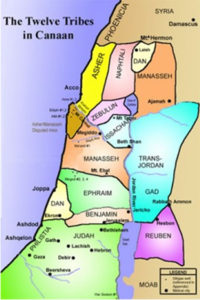
Once entering the land of Abraham, Israel conquered its enemies in the land and each of the 12 tribes of the sons of Israel were allotted their own regions.[3] Now experienced and formidable, this army of Hebrew warriors protected them even before the establishment of a kingdom.
A king, the most famous in Hebrew history, was eventually born in Bethlehem in the lineage of Judah. It fulfilled the prophetic blessing of royalty from Jacob to his son, Judah.

David, the giant-slayer, became King and ruled Israel without a Seat of the Throne until he conquered and occupied the fortified city of Jebus or Salem. Soon thereafter, the city came to be called Jerusalem, also known as Zion, the City of David, and became the capitol of Israel.

A permanent place for the Name of God to dwell required a temple. Fundamental to a theocracy, this temple needed to be located near the king’s throne in the nation’s capital to be protected against heathen enemies.

King Solomon built the Temple at the location on Mt. Moriah his father, David, had chosen. The new Temple was consecrated and blessed by Solomon, the first sacrifice offered at the new Temple on its permanent alter.

Miraculously, the sacrifices were ignited by fire sent down from heaven.[4] Known as Solomon’s Temple, the remnants one wall of the Temple, known as the Western Wall, is one of the most holy places in Israel today.[5]

God’s Law stipulated the Passover was to be celebrated at its appointed time requiring sacrifices to be offered by the priests of God at a central permanent place of worship determined to he the Temple. After the building of the Temple, the Passover was then observed there at its appointed time and the sacrifices were offered by the priests of God.[6]

For a theocratic government, the Judgement Seat also needed to be located in close proximity to both the Throne and its Temple.[7] The most important and most complicated cases of the nation were to be judged in the place God chose.

Jerusalem became the Judgement Seat of Israel under the reign of Solomon where both major civil and criminal cases were decided. In a theocratic government, God’s Law served both as the criminal code and the basis for civil laws.

Civil cases were decided in Jerusalem by King Solomon. These civil cases were decided by the King on the porch of his palace, then later on the east side of the Temple in the Hall of Judgement.[8]

Criminal cases involving the highest level of offenses, including capital death cases, were tried in the Temple Court accessed through the Chamber of Hewn Stone.[9] Built into the northern wall of the Temple, the chamber served as the meeting place for the 70 elders of Israel, eventually known as the Great Sanhedrin.[10]

Because the Hebrews did not honor their Covenant with God as the people had agreed to do at Mt. Sinai, Nebuchadnezzar destroyed and ransacked Jerusalem and the Temple. During the Persian Empire, the Temple was rebuilt under decrees by Cyrus, Darius and Artaxerxes; its gold contents returned, and observance of the annual Passover resumed until Jerusalem was destroyed by Rome in 70 AD.[11]

God’s promises from Mount Sinai laid the ground work for Israel’s future in the place and the foundation of various future Messiah prophecies. Over the coming centuries prophets Isaiah, Zechariah, Jeremiah, Micah and other prophets would give details and expectations about the coming Messiah who would come from the House of David.[12]

All the promises made by God at Mt. Sinai about “the place” came to pass. What are the odds it was all just an extraordinary coincidence?


Updated January 2, 2026.

Creative Commons License

This work is licensed under a Creative Commons Attribution-NonCommercial-NoDerivatives 4.0 International License.

REFERENCES:
[1] Deuteronomy 1:6-8, 39; 17:8-10, 14. CR Genesis 17, 22, 35, 49; Exodus 19:6; 23:20; Deuteronomy 1:8, 12:11, 16:2, 17:20.
[2] Deuteronomy 1:34-40; Numbers 13, 14:26-35.  Wood, Bryant G. BibleArchaeol0gy.org. 2009. “The Number of Israelites in the Exodus.” <https://biblearchaeology.org/research/chronological-categories/exodus-era/3943-the-number-of-israelites-in-the-exodus> “How Many Israelites Really Left Egypt?” JewishBelief.com. n.d. <https://jewishbelief.com/how-many-israelites-left-egypt/>
[3] Deuteronomy 3:12-17.  “The Twelve Tribes in Canaan.” Maps Database Source. map. 2020. <https://mapdatabaseinfo.blogspot.com/2018/05/32-map-of-promised-land-joshua.html#
[4] I Chronicles 6; Leviticus 9; Nehemiah 11.
[5] 1 Kings 6; 2 Chronicles 3.
[6] Exodus 12:14-15; Leviticus 23:4-8,; II Chronicles chapters 8, 29, 34-35:19; Ezra 6:16-22. Coulter, Fred R. cbcg.org. The Christian Passover. Chapters 12-13, Part 1. n.d. <https://www.cbcg.org/booklets/the-christian-passover/chapter-twelve-when-and-why-the-temple-sacrifice-of-the-passover-was-instituted-part-one.html>&nbsp
[7] Deuteronomy 17:8-10. CR Exodus 18.
[8] 1 Kings 3, 4, 7:7.  “Solomon’s Porch.” Encyclopedia of the Bible. n.d. <https://www.biblegateway.com/resources/encyclopedia-of-the-bible/Solomons-Porch>  “Solomon’s Porch.” BibleVerseStudy.com. n.d. <https://www.bibleversestudy.com/acts/acts5-solomons-porch.htm>  “Temple of Herod.” JewishEncyclopedia.com. 2011. <https://jewishencyclopedia.com/articles/14304-temple-of-herod> “Solomon’s Porch.” Bible-History.com. n.d. <https://bible-history.com/backdrops/solomons-porch>
[9] Schoenberg, Shira. “Ancient Jewish History: The Sanhedrin.” 2017. <http://www.jewishvirtuallibrary.org/the-sanhedrin>   Shachter, J. and Freedman, H. Soncino Babylonian Talmud. Ed. Isidore Epstein Introduction. <https://www.halakhah.com/sanhedrin/>
[10] Exodus 18; Deuteronomy 1, 17; II Chronicles 19:8:4-11.  Shachter and Freedman.  “Introduction to Sanhedrin.”  Soncino Babylonian Talmud. <https://israelect.com/Come-and-Hear/sanhedrin/index.html>  Ariel, Yisrael. “The Chamber of the Hewn Stone.” The Temple Institute. 2014. <https://www.templeinstitute.org/illustrated/hewn_stone_description.htm>  Ariel, Yisrael. “Blueprints for the Holy Temple.”  <http://www.templeinstitute.org/blueprints-for-the-holy-temple.htm>
[11] Isaiah 52-53. Sanhedrin 16a, 17a. Shachter, J. and Freedman, H.  “Sanhedrin.” Josephus.  Antiquities. Book IV, Chapter VIII.14; Book XX, Chapter IX.4. “Ancient Jewish History: The Beit Din.” Jewish Virtual Library. 2017.http://www.jewishvirtuallibrary.org/the-beit-din>
[12] Isaiah 7, 9; 11; Jeremiah 23, 33; Zechariah 3, 6, 12.

Balaam’s Prophecy to a King


Mt. Sinai was past, but then the Hebrews spent 40 years of wandering through portions of the Sinai, Negev and Arabian deserts. Delayed by two generations as a consequence of the Hebrew’s lack of faith, a promise from God remained fully in effect:  the Hebrew tribes would be protected from their enemies.[1]

Abraham, Isaac and Jacob had been promised through God’s blessings that many nations and kings would come from their descendants. Jacob divided the blessing among his sons, future fathers of the 12 tribes of Israel.

While promises made at Mt Sinai laid foundational requirements for the Messiah at the place, no particular prophecy pointed directly to the future Messiah. First of the distinctive Messiah prophecies came from a very unlikely source…

Following pillars of cloud by day and fire by night, the Hebrews were on their trek to the place.[2] Standing in the way of the Hebrews was yet another Gentile enemy, Moab,  located east of the Dead Sea in modern day Jordan, ruled by King Balak son of King Zippor.

Balak was painfully aware of how the Hebrews had vanquished the strongly defensed Amorites whose own army had previously defeated Moab and occupied many of its cities. History was poised to repeat itself for Moab, this time at the hands of the Hebrews.[3]

Dread spread throughout Moab for fear of the size and might of the Hebrew people backed by God. Knowing his military was no match for the Hebrews, the King thought that only supernatural intervention from God could save his kingdom.

Rather than asking for God’s guidance and help, the King tried a different strategy; instead, he decided to try to place a curse on the Hebrews. Balak and sent an envoy of Moabite leaders to buy the services of Balaam for that purpose.[4]

Balaam was neither a Hebrew prophet nor even familiar with them. In real time, the encounter between Balak and Balaam was unknown to the Hebrews.

Finding Balaam, an envoy presented the King’s royal request and asked him to take a night to consider it. Praying for guidance that night, God told Balaam not to return to the Balak and not to place a curse on the Hebrews because they were “blessed.”

Following the response from God, Balaam rejected the offer. Returning home, the Moabite envoy informed the King the prophet refused to return with them although it is not stated if Balak was told why Balaam declined his offer.

Undeterred, Balak upped the ante by sending back to the prophet a larger envoy with more distinguished leaders promising Balaan great honors if he would return with them to place a curse on the Hebrews. Balaam told the second envoy that even if he was offered a palace full of silver and gold, he could not do more or less than God’s commandment.

Still, Balaam said he would give the envoy an answer the next morning and that night he again sought God’s guidance. Against God’s instruction, the next day Balaam decided to go with the envoy and meet the King, but their journey was blocked by an angel using a donkey to convey the message.

Balaam became angry with the donkey not moving and, not knowing an angel was blocking its way, beat the donkey and confronted Balaam about it. Confessing he had sinned, Balaam was allowed to continue with God’s strict instructions to say only what He was instructed.

Upon arriving King Balak, who was irritated with Balaam, questioned why the prophet had resisted royal requests to come see him. Brushing off the question and getting right to the point, Balaam said,

Num 22:38 “I have come to you now, but do I have power to say just anything? The word God puts in my mouth, that is what I must say.”(NRSV)

Nevertheless, three times Balak took Balaam to a different high position on a mount  to observe portions of the extensive size of the Hebrew people who could not be seen entirely from one location. On each mount, Balak offered a sacrifice.

After each sacrifice, the King asked the prophet to place a curse on the Hebrews. Each time, Balaam sought God’s message which came back with blessings on the Hebrews rather than a curse.

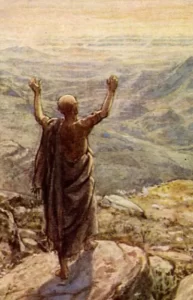
After the third time, Balak was exasperated. Clapping his hands King Balak said, “I called you to curse my enemies, but behold, you have persisted in blessing them these three times!”[5]

Announcing he was going back home, Balaam said he would foretell Moab’s future before he left.[6] It was a dark prophecy for Moab in the form of an oracle prefaced with a royal prophecy about Israel’s bright future:

Num 24:17 “I see him, but not now; I behold him, but not near; A star shall come forth from Jacob, A scepter shall rise from Israel, And shall crush through the forehead of Moab, And tear down all the sons of Sheth.”(NASB)

According to the renowned Jewish sage, Rabbi Rashi, Balaam’s oracle is a Messiah prophecy. Interpretations by the Rabbi are tied to the blessing of Jacob’s grandfather Abraham promising “kings will come forth from you.”[7]

“Scepter” is translated in the Bible from the Hebrew word shebet, the same word used in Jacob’s royalty blessing of his son, Judah, in Genesis 49:10. Rashi interpreted the term scepter as representing “a king who rules dominantly” from the future lineage of David.

Referring to the star, Rashi expounded it represents one who “shoots out like an arrow” from Jacob and uproots the sons of Sheth or Seth, the son of Adam; in other words, symbolically uproots all of mankind.[8]

If the appearance of Jesus of Nazareth was to be a fulfillment of Balaam’s prophecy, a lot of pieces first had to come together to fulfill the promises made at Mt. Sinai. Hundreds of years into the future, prophets of the Bible would bring clarity to these promises that became requirements setting the stage for the Messiah to be born in the royal lineage of the House of David.

Promises made at Mt. Sinai were fulfilled over time, but one part of Balaam’s prophecy was not yet fulfilled – “A star shall come forth from Jacob.” Was it a symbolic prophecy of someone who would uproot all of mankind or was it a literal prophecy fulfilled by “his star” observed by the Magi signaling the birth of the “King of the Jews”… perhaps both?


Updated January 3, 2026.

Creative Commons License

This work is licensed under a Creative Commons Attribution-NonCommercial-NoDerivatives 4.0 International License.

REFERENCES:

[1] Deuteronomy 2-7; 23:23-31; Number 14:24, 26-35.
[2] Numbers 14. “Sinai Peninsula;” “Negev;” and “King’s Highway.” Encyclopædia Britannica.  2014.  http://www.britannica.com
[3] Numbers 21-22. “Map of OldTestament Israel.”  Bible-history.com.  <http://www.bible-history.com/geography/ancient-israel/israel-old-testament.html> “Israel and Judah.” Free English Site. map. 2017. <http://www.freeenglishsite.com/LDS/other/Moab.htm
[4] Numbers 22. CR Deuteronomy 23:5/6.
[5] NASB. Numbers 24:10. “What is the error of Balaam?” EndoftheMatter.com. image. 2022. <https://i0.wp.com/endofthematter.com/wp-content/uploads/2021/07/BalaamintheBible-171300653-43bf701fd28844c6a5682acf05b9c83a.jpg?fit=1024%2C576&ssl=1>
[6] Numbers 24:20-24.
[7] Gensis 17:6, NASB.
[8] Rashi. The Complete Jewish Bible with Rashi Commentary  Commentary for Numbers 24:17.