Cicero’s Prosecution of Murder By Crucifixion


Crucifixion is as closely associated with the image of Jesus of Nazareth as any other save perhaps the Nativity manger scene. Still, some dispute Rome’s execution of Jesus by nailing him to a cross.[1]
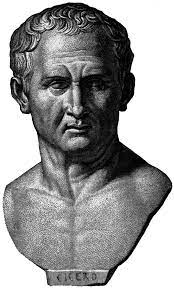
Cicero

Cicero, commonly regarded as the greatest orator in Roman history, was a Senator and Consul who lived about 100 years before Pontius Pilate was Procurator of Judea.[2] A lesser known fact is that Cicero was a prosecutor, a Roman lawyer.

Secondary Orations Against Verres written by Cicero narrates his prosecution of Verres charged with premeditated murder by crucifixion of a noble Roman citizen, Publius Gavius.[3] Motive of the murder was punishment for Gavius who publicly crusaded for freedom and citizenship.

Directed squarely at Verres, the prosecutorial words of Cicero delineates the crucifixion process Verres used to kill Gavius:[4]

“…according to their regular custom and usage, they had erected the cross behind the city in the Pompeian road…you chose that place in order that the man who said that he was a Roman citizen, might be able from his cross to behold Italy and to look towards his own home?… for the express purpose that the wretched man who was dying in agony and torture might see that the rights of liberty and of slavery were only separated by a very narrow strait, and that Italy might behold her son murdered by the most miserable and most painful punishment appropriate to slaves alone.

It is a crime to bind a Roman citizen; to scourge him is a wickedness; to put him to death is almost parricide. What shall I say of crucifying him? So guilty an action cannot by any possibility be adequately expressed by any name bad enough for it…that you exposed to that torture and nailed on that cross…He chose that monument of his wickedness and audacity to be in the sight of Italy, in the very vestibule of Sicily, within sight of all passersby as they sailed to and fro.”

“…it was the common cause of freedom and citizenship that you exposed to that torture and nailed on that cross.[5]

Scourging whips and a cross were the murder weapons – death by crucifixion, consistent with today’s medical science finding of injuries inflicted by a crucifixion. Humiliation, psychological and mental anguish were part of the excruciating, long lasting torment and death of Gavius.

Crucifixion was a manner of execution reserved only for slaves at that time in Roman history. Verres was allowed to self-exile to Massalia in southern France, then sentenced in abstentia to merely an undisclosed fine.

All four Gospels record that Jesus of Nazareth was scourged, nailed to a cross and killed by crucifixion. Gory specifics of a crucifixion are described in limited detail for one very simple reason – it was not necessary.

“Tacitus (“Annales,” 54, 59) reports therefore without comment the fact that Jesus was crucified. For Romans no amplification was necessary.” – Jewish Encyclopedia

Not even Roman historians Josephus, Tacitus or Suetonius found it necessary to explain crucifixion.[7] Just about everyone living in the Roman Empire knew about crucifixion – shouting out “crucify him!” the rowdy Jewish crowd at Pilate’s judgement of Jesus certainly knew about it.[6]

Seneca the Younger was born in Spain, educated in Rome, and became a stoic philosopher, statesman and dramatist with a penchant for including horror scenes in his tragedies. His life corresponded virtually with the same years as Jesus of Nazareth.

“Dialogue” is another name for a letter written by Seneca for which he is known to have written several. In the Dialogue To Marcia on Consolation, Seneca used a metaphor of crucifixion to his embittered friend who had been grieving three years over her son’s death.[8]

Obviously familiar with the gruesome realities of crucifixion, the letter suggests he expected Marcia to be familiar with it. Describing the mental anguish of people of virtue striving to overcome their own self-imposed tribulations, he wrote:

“Though they strive to release themselves from their crosses those crosses to which each one of you nails himself with his own hand – yet they, when brought to punishment, hang each upon a single gibbets [sic]; but these others who bring upon themselves their own punishment are stretched upon as many crosses as they had desires….”[9]

Generally, a “gibbet” is believed to be a gallows-like structure or an upright pole typically used to hang executed victims’ bodies by chains or ropes for public display as a method of scorn. By comparison, crucifixion involved living victims who were “stretched” out and nailed to crosses.[10]
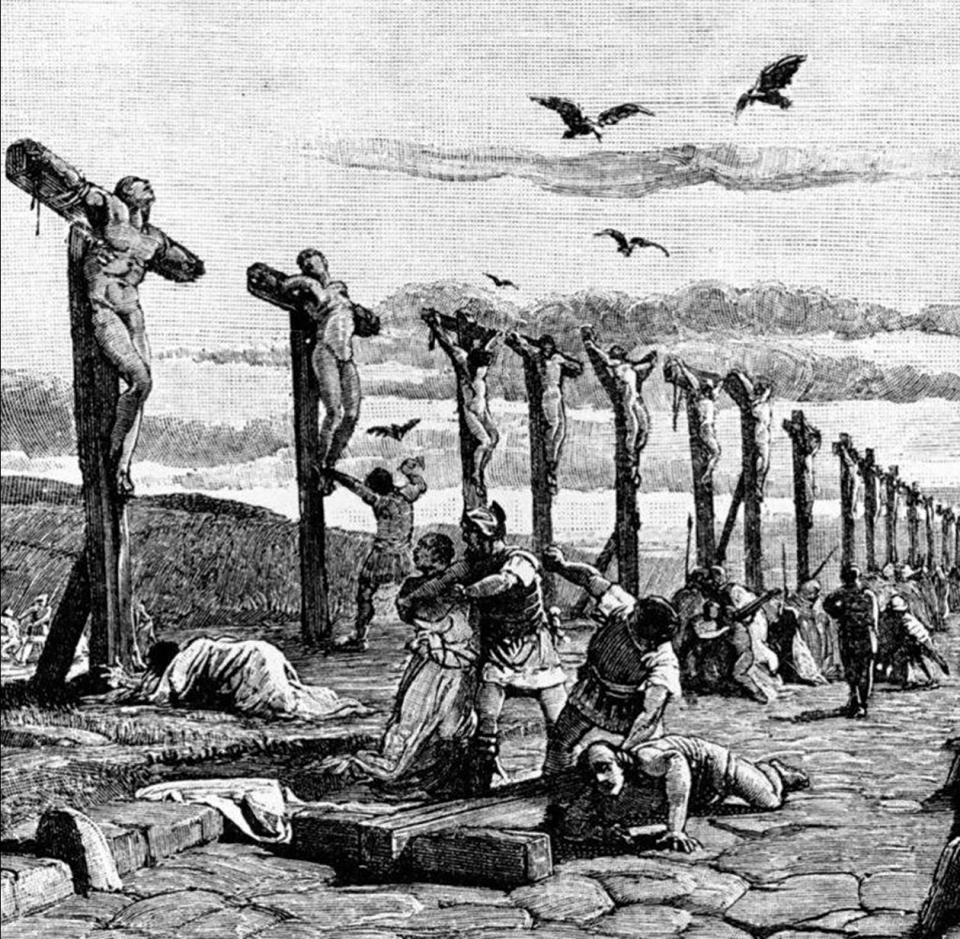
 
Jewish historian Josephus personally witnessed crucifixions initially used by Rome to punish such crimes as robbery and insurrection. Eventually crucifixions, he wrote,  devolved to the point of becoming Roman sport.[11]

Nine references to Roman crucifixion are made by Josephus in which no Jew was safe. In one, he wrote of crucifixions by Procurator Florus and in another from his own eyewitness perspective during the siege of Jerusalem in 70 AD:[12]

“…for Florus ventured then to do what no one had done before, that is, to have men of the equestrian order whipped and nailed to the cross before his tribunal; who although were at birth Jews, yet were they of Roman dignity notwithstanding.”[13]

“So the soldiers, out of the wrath and hatred they bore the Jews, nailed those they caught, one after one way, and another after another, to the crosses, by way of jest, when their multitude was so great, that room was wanting for the crosses, and crosses wanting for the bodies.”[14]

Are the Gospels credible in saying that Roman crucifixion by being nailed to a cross was the means used to kill Jesus?


Updated May 12, 2025.

Creative Commons License

This work is licensed under a Creative Commons Attribution-NonCommercial-NoDerivatives 4.0 International License.

REFERENCES

[1] “Jesus did not die on cross, says scholar.” The Telegraph. n.d. <http://www.telegraph.co.uk/news/religion/7849852/Jesus-did-not-die-on-cross-says-scholar.html rel=”nofollow” rel=”nofollow”> Warren, Meredith J.C.  “Was Jesus Really Nailed to the Cross?”  The Conversation. 2016. <https://theconversation.com/was-jesus-really-nailed-to-the-cross-56321 rel=”nofollow”>   Perales, Ginger. “Was Jesus Nailed or Tied to the Cross?”  2016.  <http://www.newhistorian.com/jesus-nailed-tied-cross/6161 rel=”nofollow”>
[2] Linder, Douglas O. Imperium Romanun. “The Trial of Gaius (or Caius) Verres.” 2008. <http://law2.umkc.edu/faculty/projects/ftrials/Verres/verresaccount.html>  Bunson, Matthew. Encyclopedia of the Roman Empire. “Cicero; Cicero, Marcus Tillius.” <https://archive.org/details/isbn_9780816045624
[3] Cicero, Marcus Tullius. “The Fifth Book of the Second Pleading in the Prosecution against Verres.” Ed. Crane, Gregory R. <http://www.perseus.tufts.edu/hopper/text?doc=Perseus%3Atext%3A1999.02.0018%3Atext%3DVer.%3Aactio%3D2%3Abook%3D5>
[4] Greenough, James. B.; Kittredge, George; eds.   Select Orations and Letters of Cicero.  1902.  Introduction I.  Life of Cicero. VII. “From the Murder of Caesar to the Death of Cicero.” <http://books.google.com/books?id=ANoNAAAAYAAJ&pg=PR1#v=onepage&q&f=false>   Quintilian, Marcus Fabius.  Quintilian’s Institutes of Oratory. 1856. Book 8, Chapter 4. Rhetoric and Composition. 2011. <http://rhetoric.eserver.org/quintilian/index.html>  “Crucifixion.” JewishEncyclopedia.com < http://jewishencyclopedia.com/articles/4782-crucifixion > “Trial of Gaius Verres – governor of Sicily.” Imperium Romanun. 2021. <https://imperiumromanum.pl/en/article/trial-of-gaius-verres-governor-of-sicily/> Linder. “The Trial of Gaius (or Caius) Verres.”  Sack, Harald. SciHi Blog. “Marcus Tullius Cicero – Truly a Homo Novus.” image. 2020. <https://www.google.com/imgres?imgurl=http%3A%2F%2Fscihi.org%2Fwp-content%2Fuploads%2F2014%2F12%2FCicero-619×1024.png&tbnid=7Et1cliwXqmeIM&vet=10CAQQxiAoAmoXChMIwI731KCFgwMVAAAAAB0AAAAAEA0..i&imgrefurl=http%3A%2F%2Fscihi.org%2Fmarcus-tullius-cicero-homo-novus%2F&docid=iBCg84NfCo2gMM&w=619&h=1024&itg=1&q=images%20of%20Cicero&client=firefox-b-1-d&ved=0CAQQxiAoAmoXChMIwI731KCFgwMVAAAAAB0AAAAAEA0
[5] Cicero. “The Fifth Book of the Second Pleading in the Prosecution against Verres.”
[6] Josephus, Flavius. Wars of the Jews. Book IV, Chapter V. <http://books.google.com/books?id=e0dAAAAAMAAJ&printsec=frontcover&source=gbs_ge_summary_r&cad=0#v=onepage&q&f=false>
[7] Tacitus, Gaius Cornelius. The Annals. Ed. Church, Alfred John and Brodribb, William Jackson. <http://www.perseus.tufts.edu/hopper/text?doc=Perseus:text:1999.02.0078> Perseus Digital Library. Ed. Crane, Gregory R. Tufts University. n.d. Word search “crucified” <http://www.perseus.tufts.edu/hopper/searchresults?page=4&q=crucified>  Suetonious. The Lives of the Twelve Caesars.  “The Life of Augustus.” #57, Footnote “e.” <https://penelope.uchicago.edu/Thayer/E/Roman/Texts/Suetonius/12Caesars/Augustus*.html#ref:no_crucifixions_when_Augustus_entered_a_city>
[8] “Seneca.”  Stanford Encyclopedia of Philosophy. Ed. Zalta, Edward N.  2015. <https://plato.stanford.edu>  Mastin, Luke. “Ancient Rome – Seneca the Younger.” 2009. Classical Literature. <http://www.ancient-literature.com/rome_seneca.html>
[9] Seneca, Lucius Annaeus. “De Consolatione Ad Marciam+.” “To Marcia on Consolation.” Moral Essays. Trans. John W. Basore.  1928-1935.   “Seneca’s Essays Volume II.”  Book VI.  Pages xx 1-3.  The Stoic Legacy to the Renaissance.  2004.  <http://www.stoics.com/seneca_essays_book_2.html#%E2%80%98MARCIAM1>   Seneca, Lucius Annaeus. “De Vita Beata+.” “To Gallio On The Happy Life.” Moral Essays. Trans. John W. Basore. 1928-1935. “Seneca’s Essays Volume II.”  Book VII. The Stoic Legacy to the Renaissance. 2004. <http://www.stoics.com/seneca_essays_book_2.html#%E2%80%98BEATA1>
[10] “gibbet.” The Free Dictionary by Farlex. 2022. <https://www.thefreedictionary.com/gibbet>“gibbet.” Merriam-Webster.com. 2022. <https://www.merriam-webster.com/dictionary/gibbet>
[11] “Crucifixion.” JewishEncyclopedia.com.  Ciantar, Joe Zammit. Times Malta. “Recollections on Crucifixion – Part one.” image. 2022. <https://timesofmalta.com/articles/view/recollections-on-crucifixion-part-one.861097>  Champlain, Edward. Nero. Harvard University Press. 2009. <https://books.google.com/books?id=30Wa-l9B5IoC&lpg=PA122&ots=nw4edgV_xw&dq=crucifixion%2C%20tacitus&pg=PP1#v=onepage&q&f=false
[12] “FLORUS, GESSIUS (or, incorrectly, Cestius).” JewishEncyclopedia.com. <http://www.jewishencyclopedia.com/articles/6200-florus-gessius>
[13] Josephus, Flavius. Wars of the Jews. Book II, Chapter XIV. <http://books.google.com/books?id=e0dAAAAAMAAJ&printsec=frontcover&source=gbs_ge_summary_r&cad=0#v=onepage&q&f=false>
[14] Josephus. Wars. Book V, Chapter XI.
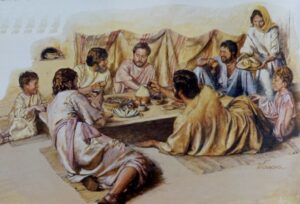
It’s All About a Meal


Tradition says Jesus was crucified on Good Friday of Easter weekend. Not everyone agrees – some say that Jesus of Nazareth was crucified earlier in the week or even before the Feast of Unleavened Bread.[1] A meal plays a big role in determining when Jesus was crucified…and it may not be the one that first comes to mind.

JN 18:28 Then they took Jesus from Caiaphas to Pilate’s headquarters. It was early in the morning. They themselves did not enter the headquarters, so as to avoid ritual defilement and to be able to eat the Passover.(NRSV)

John says the priests were worried about becoming defiled which would then disqualify them from eating the Passover meal.[2] It is easy to draw the conclusion that “to eat the Passover” refers to the Feast of Unleavened Bread, but it had already been eaten.

Playing this out farther, if the verse is referring to the Feast of Unleavened Bread, it would mean Jesus was crucified on Nisan 14th before the Feast. In this scenario John 18:28 would then indeed be a contradiction with the other Gospel accounts saying Jesus was crucified and died on the first day of Passover.[3]

Many people may not be aware there were two other meal possibilities at the beginning of Passover called a chagigah defined in the Talmud.[4] It is helpful to know the Jewish day begins at sunset and the following sunrise begins the daylight portion of that same day ending at dusk.

First of the two Passover meals was an optional supplement to the Feast of Unleavened Bread. If it was necessary to feed a larger party, an optional first chagigah sacrifice was to be offered in addition to the Pascal lamb sacrifice and treated the same way.

Another, separate chagigah was also  offered on Nisan 14 and eaten the first day of Passover.[5] This second chagigah sacrifice meal was to be consumed over the course of two days and one night.[6]

Jewish Law stipulated that a portion of the sacrifice was to be given to God, a portion to the Priest as a tithe for his own meal, and the remaining portion of meat to be taken home by the offerer for his own Chagigah meal.[7] As such, the priests were  beneficiaries to this sacrifice.

Priests were held to a higher Rabbinical standard with special rules that did not apply to the general populace. Entering Pilate‘s headquarters, the Praetorium in John 18:28, was one of those things that would place the priests in a state of ritual defilement. Rabbinic ritual defilement could be absolved by means of a ritualistic purification bath.[8]

Since the Feast of Unleavened Bread occurred after sunset, a priest ritually defiled the day of Nisan 14th could still partake of the Feast of Unleavened Bread if he performed a ritual purification bath before sunset. On the other hand, the second chagigah meal was to be consumed during the first day of Passover meaning a ritual purification bath for defilement on Nisan 14th was not applicable for Nisan 15th.

Defilement worries in John 18:28 “to be able to eat the Passover” centered on the consequences involving the second chagigah meal by the Priests. Disqualification from performing their chagigah sacrificial duty on the first day of Passover meant the priests would not have received their lawful gratuity portion of the sacrificial meat – no meat for their own chagigah meal on the first day of Passover.[9] 

Logically, perhaps even much bigger, is why the defilement concern of John 18:28 over a meal is just one factor. Offerings of the Pascal sacrifices on Nisan 14th was an all-hands-on-deck scenario, according to Josephus, where upwards of a quarter million paschal sacrifices were performed at the Temple!

All the Priests served a vitally important role at the Temple requiring massive preparations with a packed and rigid schedule. Activities for the most popular annual Festival in all the land drew crowds of about 3 million people.[10]

Consider a Thursday crucifixion scenario where high level priests pursued their vendetta against Jesus beginning after the evening dinner of Nisan 13th with an arrest, an inquisition and an aberrant overnight trial; Roman hearings the next morning; and ended with the crucifixion of Jesus at 9am, Nisan 14th while at the very same time tens of thousands of pascal lamb sacrifices were being sacrificed at the Temple. This scenario would be like NFL Super Bowl event managers taking the day off on Super Bowl Sunday to attend to personal business.

Another factor to consider is the Romans who were worried by the Passover observance more than any other Jewish holiday because it drew to Jerusalem the potentially troublesome Jewish crowds of millions of pilgrims.[11] The risk of a riot on the Nisan 15th was much less than for a crucifixion on the first day of Passover.

Jews would be in their local housing accommodations having just celebrated the Passover on Nisan 15th with very minimal activity in compliance with religious law. As opposed to Nisan 14th, Jews were out and about without the same restrictions.

Did John’s reference to the priest’s defilement concern of missing the Passover meal actually pose a credibility issue with the other Gospels that said Jesus was crucified on the first day of Passover?


Updated June 30, 2025.

Creative Commons License

This work is licensed under a Creative Commons Attribution-NonCommercial-NoDerivatives 4.0 International License.

REFERENCES:

NRSV = New Revised Standard Version translation

[1] Doig, Kenneth F. New Testament Chronology.  Chapter 18.  <http://nowoezone.com/NTC18.htm>  Edersheim, Alfred.  The Life and Times of Jesus the Messiah. 1883. Book V.  <http://philologos.org/__eb-lat/default.htm> “Sharing a Meal.” Pinterest.com. image. n.d. <https://www.pinterest.com/pin/785737466232633826/>
[2] Wells, Steve.  The Skeptic’s Annotated Bible. 2017. “423. When was Jesus crucified?” http://skepticsannotatedbible.com/contra/passover_meal.html> “101 Bible Contradictions.”  Islamic Awareness. n.d. Contradiction #69. https://www.islamawareness.net/Christianity/bible_contra_101.html>
[3] Edersheim, Alfred. The Temple – Its Ministry and Services. Chapter 10. 1826 -1889. The NTSLibrary. 2016. <http://www.ntslibrary.com/PDF%20BooksJewish Encyclopedia.  2011. <http://www.jewishencyclopedia.com>
[4] Leviticus 23:7-8; Numbers 28:18. Net.Bible.org. Hebrew text, footnote #20.  CR Exodus 23:14.  Netbible.org. n.d. Hebrew text. “G5656.” Lexicon-Concordance. n.d. <http://lexiconcordance.com/search6.asp?sw=5656&sm=0&x=0&y=0 Babylonian Talmud. Rodkinson trans. Book 3, Tracts Pesachim, Chapter IV and Book 4, Tract Betzah (Yom Tob); Book 4, Tract Moed, Chapter II.. <https://www.sacred-texts.com/jud/talmud.htm#t03>
[5] Leviticus 3.
[6] The Babylonian Talmud. Trans. Michael L. Rodkinson.  1918.  Book 3, Tract Pesachim.  <http://www.sacred-texts.com/jud/talmud.htm>   Streane, A. W, ed. A Translation of the Treatise Chagigah from the Babylonian Talmud.  1891. Chagigah 7b.  <http://www.archive.org/stream/translationoftre00streuoft/translationoftre00streuoft_djvu.txt>
[7] Leviticus 7:29-32.  Edersheim. The Temple – Its Ministry and Services. Chapters 5 & 11.  Streane.  A Translation of the Treatise Chagigah from the Babylonian Talmud.  Glossary: “Chagigah.”
[8] Leviticus 22. “Exploring Qumran: The Dead Sea Scrolls Community.” MSN.com. video. 2025. <https://www.msn.com/en-us/video/peopleandplaces/exploring-qumran-the-dead-sea-scrolls-community/vi-AA1xfbCq?ocid=msedgntp&pc=HCTS&cvid=4e309000c75e45b69d296288be2ab1f9&ei=287#details>
[9] Leviticus 22; Numbers 9. Josephus, Flavius.  Antiquities of the Jews. Book III, Chapter X. Google Books.  n.d <http://books.google.com/books?id=e0dAAAAAMAAJ&printsec=frontcover&source=gbs_ge_summary_r&cad=0#v=onepage&q&f=false>
[10] Josephus, Flavius.  Wars of the Jews. Book VI.. < http://books.google.com/books?id=e0dAAAAAMAAJ&printsec=frontcover&source=gbs_ge_summary_r&cad=0#v=onepage&q&f=false>
[11] Antiquities. Book XI, Chapter IV; Book XX, Chapter V. Josephus. Wars. Book V, Chapter V.

Jerusalem – the Messiah Connection


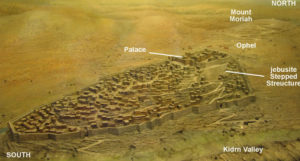
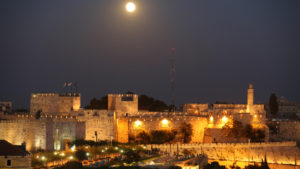
Jerusalem’s Old City today

Jerusalem, an ancient, world-famous city with no natural wealth or strategic value – no harbor, no navigable waterway, no major trade routes, militarily isolated with valleys on all four sides, not even a natural water source within its walls – an improbable city in the desert.[1]

Happenings of great religious significance began at the place about 1000 years before the future city would ever come to be called Jerusalem. The city’s entire existence is based almost solely on its religious heritage.

A 2000-year history preceded the era of Jesus of Nazareth. Salem/Jebus/Jerusalem produced a legacy of kings, births, deaths, prophecies, angels, sacrifices, blessings, wars, exile and restoration.

Going back in history, one day God instructed Abram to move from Haran (in present day Iran) to an unnamed location in Canaan. Abram and his family resettled in a strange land near Salem whose King was Melchizedek and also a priest of God.[2]

During these years, God blessed Abram, changed his name to Abraham and promised he would become the father of a great nation.[3] His miraculously-born son, Isaac, would pass on his father Abraham’s blessing.

One of Isaac’s twin sons was named Jacob, his name was later changed by God to Israel. Based on a lie perpetrated by his other brothers to their father, Joseph was very much alive, but had been sold into slavery.[4]

Many years later Israel, along with his 11 other sons and their families, Israel moved to Egypt because of a famine. Unbeknownst to the entire family,  Joseph had become the second most powerful man in Egypt next only to Pharaoh, revealed his true identity and protected the family of Jacob.[5]

Over the next 400 years, the 12 tribes of the Children of Israel became slaves of Egypt. Meanwhile back in Canaan during the absence of the clan of Israel, the Jebusites occupied Salem coming to be known as Jebus.[6]

Fleeing Egypt, the Hebrews miraculously escaped through the Red Sea arriving at Mt. Sinai. Five big promises in the Law given to Moses atop Mt. Sinai tied to the place – God just didn’t say exactly where the place would be.[7]

All promises required a city – a new homeland for the city;  the throne for a king; a permanent place for His Name to dwell; a permanent place to observe the Feasts; and the place of the judgment seat of Israel.

As a visual sign of His promise, God sent an angel in the form of a pillar of cloud by day; by night, a pillar of fire. Both were designed to remind the Hebrew nation of God’s presence and  to lead them to the place that He had chosen.

EX 23::20, 23 “See, I am sending an angel ahead of you to guard you along the way and to bring you to the place I have prepared.… “For My angel will go before you and bring you in to the land of the Amorites, the Hittites, the Perizzites, the Canaanites, the Hivites and the Jebusites…”(NASB)

EX 33:1-2 “Then the LORD spoke to Moses, “Depart, go up from here, you and the people whom you have brought up from the land of Egypt, to the land of which I swore to Abraham, Isaac, and Jacob, saying, ‘To your descendants I will give it.’” I will send an angel before you and I will drive out the Canaanite, the Amorite, the Hittite, the Perizzite, the Hivite and the Jebusite.” (NASB)

God twice called out the occupants of Salem – the Jebusites.[8] Problem was that the fortified city was occupied by the Jebusites and every attempt by the fledgling Hebrew nation to defeat the Jebusites had been unsuccessful.[9]

David had become famous as a giant slayer and skilled warrior while serving in King Saul’s army.[10] As King himself, David gathered the Hebrews from the surrounding areas to form a large army, went to war with Jebus and took the city.

Jerusalem about 1000 BC.

Salem – Jebus – Zion was now called the City of David coming to be known as the City of Jerusalem. Jerusalem became the capital of Israel and the throne of King David fulfilling two of God’s promises.

Mount Moriah was now within Jerusalem. King Solomon built the Temple  on Mt. Moriah becoming the place where the Passover was celebrated at its appointed time.[11]

An interwoven trail of blessings, testing of faith, much drama, prophecies made and fulfilled over the course of a millennia, all climaxed with the glory days of Jerusalem under King David. Splendor would be short lived – the end of David’s reign marked the beginning of the nation’s deterioration.

Spiraling out of control, the downhill slide led to the point all would be eventually lost. Jerusalem with its Temple was destroyed by Nebuchadnezzar and select inhabitants were exiled to Babylon.

A millennium after its height of glory during David’s reign, a comeback for Jerusalem came under King Herod. During that era, Jesus of Nazareth appeared on the scene, born in the same town as David, Bethlehem, and in the royal lineage of King David.

Consistent with multiple Messiah prophecies, the life of Jesus culminated when he was placed on trial in Jerusalem and crucified, consistent with multiple Messiah prophecies. Were these just multiple coincidences or was Jesus the promised Messiah?


Updated January, 2025.

Creative Commons License

This work is licensed under a Creative Commons Attribution-NonCommercial-NoDerivatives 4.0 International License.

REFERENCES:

[1] Gersch, Lili Kalish. MyJewishLearning. “Whose Jerusalem?” photo. n.d. <https://www.myjewishlearning.com/article/whose-jerusalem>  “Jerusalem .”  New World Encyclopedia.   “Jerusalem Archaeological Sites: Biblical Water Systems.”  Jewish Virtual Library. 2014.
[2] Genesis 11-15.  “Historical Timeline.” The Biblical Zionist. 2009.  <http://www.biblicalzionist.com/timeline.htm>  Uittenbogaard, Arie. “Salem meaning | Salem etymology.”  <http://www.abarim-publications.com/Meaning/Salem.html#.U5SQqCjyTih> Josephus. Wars of the Jews. Book VI, Chapter X.
[3] Genesis 17.
[4] Genesis 32, 35.
[5] Genesis 43; I Chronicles 2:1-2.
[6] I Chronicles 11; Judges 1, 19; Joshua 15; Psalms 76.
[7] Exodus 23, 33; Deuteronomy 12, 17.
[8] Deuteronomy 3:12-22. Ryrie Study Bible. Ed. Ryrie Charles C. “Laws relating to conquests” ref. Ex. 23:20-33.
[9] II Samuel 5:6; I Chronicles 11. “Zion.” Encyclopædia Britannica. 2024. <https://www.britannica.com/place/Zion-hill-Jerusalem>
[10] I Chronicles 11:1-3.
[11] I Chronicles 17:8-13. Josephus, Antiquity of the Jews, Book VII, Chapter III.1-2. “The Temple.” The Victor’s Place. image. Feb. 2. ? <https://images.search.yahoo.com/yhs/search;_ylt=AwrCwOUslAdjzRoASQ0PxQt.;_ylu=Y29sbwNiZjEEcG9zAzEEdnRpZAMEc2VjA3BpdnM-?p=The+Temple%2C+Jerusalem&type=yhs-adk_sbnt_appfocus1_sm_ff&param1=20210118&param2=00000000-0000-0000-0000-000000000000&param3=searchmanager_%7EUS%7Eappfocus1%7E&param4=%7Efirefox%7E%7E&hsimp=yhs-adk_sbnt&hspart=adk&grd=1&ei=UTF-8&fr=yhs-adk-adk_sbnt#id=96&iurl=https%3A%2F%2Fvhoagland.files.wordpress.com%2F2021%2F02%2Fdsc00129.jpg&action=click>