The Trial of Jesus — Guilty or Innocent?


Jesus of Nazareth had been arrested by a posse of the Jewish leadership in the Garden of Gethsemane outside Jerusalem. Escorted by the armed guards back into the city, Jesus would be aberrantly tried on the charge of blasphemy as defined in the Law of Moses.[1]

Prosecuting the case in defense of God’s Law was Chief Priest Caiaphas and the defendant representing himself was Jesus of Nazareth. The verdict of the aberrant trial would have colossal implications in one of two very different ways.

Rome would surely react unfavorably to any potential new Jewish figurehead if they did nothing. A conviction as an insurrectionist and tax evader might be viewed by Rome positively and trouble could be averted.

Conviction from a Jewish perspective would publicly label Jesus as a blasphemer worthy of death, not worship. God’s Law would be successfully defended and upheld.

Acquittal would mean, at the very least, that Jesus would likely be considered the Son of God, worthy of worship. Such a verdict would be an embarrassment for the Jewish Council and pose a threat to their religious political power base.

As an added bonus, a conviction would eliminate the subversive threat to the Jewish leaders political power base. A Jewish Talmud Gemara would later expose the reasoning:[2]

San 49b “…thus the blasphemer and the idol-worshipper are executed.  Wherein lies the particular enormity of these offences? — Because they constitute an attack upon the fundamental belief of Judaism.”[3]

Gravity of the situation called for a fair and thorough trial, but how likely was that reality? At stake was the defense of Judaism, a religious institution headed by the same power base that was responsible for rendering the verdict – the prosecution witnesses even came from among those serving as judge and jury.[4]

Defense witnesses for Jesus were nowhere to be found. Not because there weren’t any, but being under the threat of death themselves, who would come forward in his defense?[5] Even his most stalwart disciple, Peter, upon whom Jesus had declared he would build his church would deny knowing Jesus three times that very night as the aberrant trial progressed.

Other ominous signs did not favor a fair trial given it was not conducted in accordance with Jewish law. Legal code in the Talmud defined how capital offenses were to be tried and convictions rendered. Among them:[6]

MISHNA: Sanhedrin 32a:

“Capital charges must be tried by day and concluded by day.”

“In capital charges, anyone may argue in his favour, but not against him.”

“Capital charges may be concluded on the same day with a favourable verdict, but only on the morrow with an unfavourable verdict therefore trials are not held on the eve of a Sabbath or Festival.”

Pretrial events began at the residence of Annas, a Sanhedrin power broker, former Chief Priest and father-in-law of Chief Priest Caiaphas. Annas began with cursory questions asking Jesus about his disciples and his teachings. Jesus replied that he had always spoken openly in the Temple and synagogues – there were no secrets.

“Why do you ask me? Ask those who heard what I said to them; they know what I said.”(NRSV)

Not sitting well with his captors, one of them reacted by hitting Jesus. Holding firm, Jesus again challenged his captors saying:

“If I have spoken wrongly, testify to the wrong. But if I have spoken rightly, why do you strike me?””(NRSV)

With this, Annas sent the posse with their blindfolded and bound prisoner to Caiaphas. By the time they arrived at the Sanhedrin meeting hall at the Temple, Jesus had been mocked and beaten.

Chief Priest Caiaphas presided over the trial held that fateful night. The Law required two eyewitnesses to corroborate the same point of evidence to establish a fact for a conviction.[8]

Initially the High Priest’s prosecution effort was not going well with many accusers coming forward; however, no two witness testimonies could agree.[9] Finally, two witnesses made the same accusation: “We heard Him say, ‘I will destroy this temple made with hands, and in three days I will build another made without hands.’”

Not quite the same, Jesus actually had said, “Destroy this temple, and in three days I will raise it up.”[10] Nevertheless, Jesus was accused of saying he would destroy the Temple and rebuild it in just three days when previously it took 46 years to build.

Implying only God could do this, it created an opening, Caiaphas understood the implications. He pounced on the moment with an indicting question that cut to the heart of the trial:

MK 14.61 “Are you the Messiah, the Son of the Blessed One?” (ISV, NLT, NRSV)

An answer in the affirmative would be self-incriminating and condemning. It was the moment of truth – was Jesus of Nazareth willing to put his life on the line knowing that he would die if he acknowledged this to be true? The answer to Caiaphas was unambiguous:

I am.

To be crystal clear, Jesus added:

MK 14:62 “’you will see the Son of Man seated at the right hand of the Power’ and ‘coming with the clouds of heaven.’”ISV, NET, NRSV)

Immediately the verdict was rendered when Chief Priest Caiaphas tore his robe and said,

MT 26:65 “He has blasphemed! What further need do we have of witnesses?”(NASB)

Sentencing was still not a slam dunk. Under Rome’s laws, the Jews were not allowed to carry out capital punishment.[11]

Would a heathen Roman government even entertain a charge of blasphemy based solely in Jewish religious law? Probably not, they figured.

On the outside chance Rome did level such a charge, would they issue a death penalty judgement for blasphemy? Even more unlikely.[12]

Considering their options, the Jewish Council sought to convince Pilate that Jesus was guilty of failure to pay taxes to Caesar and for insurrection to Rome. Either of those charges could result in the Roman death penalty.

For Pilate, the accusation of insurrection was a hot button issue with Rome having battled insurrections throughout his tenure as Procurator … at least this was assumed to be the case.[13] Ultimately, Pilate found Jesus to have no guilt on either charge. Subsequent Jewish political pressure compelled Pilate to sentence Jesus to be crucified.

Was the trial of Jesus fair or was the verdict a divinely predestined outcome?


Updated May 18, 2025.

NASB = New American Standard Bible translation
ISV = International Standard Version translation
NLT = New Living Translation
NRSV = New Revised Standard Version translation
Gospel accounts:  Matthew 26-27, Mark 14-15, Luke 22-23, John 18-19.

Creative Commons License

This work is licensed under a Creative Commons Attribution-NonCommercial-NoDerivatives 4.0 International License.

REFERENCES:

[1] Leviticus 24:15-16. John 18:3, 12: “chiliarchos <5506>” and “speira <4686>”. CR Edersheim, Alfred.  The Life and Times of Jesus the Messiah. 1883. Book V, Chapter 15, pp 1382-1392 & pp 1393-1421. <http://philologos.org/__eb-lat/default.htm>  Edersheim, Alfred. The Temple – Its Ministry and Services. Chapter 10. 1826 -1889. The NTSLibrary. 2016. <http://www.ntslibrary.com/PDF%20Books/The%20Temple%20by%20Alfred%20Edersheim.pdf>Babylonian Talmud. Windle, Bryan. “Caiaphas: An Archaeological Biography.” BibleArchaelogyReport.com. April 17, 2025. <https://biblearchaeologyreport.com/2025/04/17/caiaphas-an-archaeological-biography
[2] “Lady Justice.” ClipArtBest.com. image. 2022. <http://www.clipartbest.com/clipart-4cbo7xgei>  Wiewel, Brad. The Trial of Jesus Christ from a Legal View. Texas Trust Law. video. 2025. https://www.youtube.com/watch?v=kEYcTsWBgoM.
[3] Soncino Babylonian Talmud. Ed. Isidore Epstein. 1935 – 1948. Sanhedrin 49b.<https://israelect.com/Come-and-Hear/sanhedrin/index.html>
[4] Josephus. Against Apion. Book II. <http://books.google.com/books?id=e0dAAAAAMAAJ&printsec=frontcover&source=gbs_ge_summary_r&cad=0#v=onepage&q&f=false>  Spiro, Ken. “History Crash Course #39: The Talmud.” <http://www.aish.com/jl/h/cc/48948646.html>  Valentine, Carol A. . “The Structure of the Talmud Files.” <https://israelect.com/Come-and-Hear/structure.html> CR Numbers 30:35.
[5] Sanhedrin 43a.
[6] Sanhedrin 32a – 36b.; CR. Deuteronomy 19:16-18.
[7] Edersheim, Alfred. The Life and Times of Jesus the Messiah. 1883. Chapter 13.  The NTSLibrary. 2016. <http://www.ntslibrary.com/PDF%20Books/The%20Life%20and%20Times%20of%20Jesus%20the%20Messiah.pdf> Josephus.  Antiquities. Book XX, Chapters IX.1 & X.1; Book XVIII, Chapter IV.   Whitson, William. The Complete Works of Josephus. 1850. Footnotes – Book XX, Chapter VIII. <http://books.google.com/books?id=e0dAAAAAMAAJ&printsec=frontcover&source=gbs_ge_summary_r&cad=0#v=onepage&q&f=false>
[8] Deuteronomy 17:6, 19:15; Numbers 35:30.  Sanhedrin 9a, 30a.  Resnicoff, Steven H. “Criminal Confessions in Jewish Law .“  2007. <http://www.torah.org/features/secondlook/criminal.html>
[9] Sanhedrin 41a.  “Capital Punishment.” Jewish Virtual Library. http://www.jewishvirtuallibrary.org/capital-punishment>
[10] John 2:19. NASB.
[11] Sanhedrin 41a. “Capital Punishment.” Jewish Virtual Library. http://www.jewishvirtuallibrary.org/capital-punishment>
[12] Edersheim, The Life and Times of Jesus the Messiah. Book V, Chapter 14.
[13] Forsythe, Gary Edward.  “Ancient Rome – The Roman Army.” 2007.  <http://history-world.org/roman_army.htm>
 Preparation Day – Did John Contradict Himself?


Preparation Day is mentioned several times in the Gospels, but two verses in John seem to create a conflict. Some critics point to two Preparation Day references as being a contradiction thereby casting doubt on the integrity of Gospel accounts about Jesus of Nazareth.[1]

In the first verse, “Preparation Day” seems to precede the Passover because it says Jesus was judged by Pilate obvious before he was crucified:

JN 19:14 “Now it was the Preparation Day of the Passover, and about the sixth hour. And he said to the Jews, “Behold your King!”” (NKJV)

John’s second reference to the “Preparation Day” a few verses later seems contradictory to verse 14 when it says the crucified body of Jesus was removed from the cross leading into the Sabbath:

JN 19:31 “Therefore, because it was the Preparation Day, that the bodies should not remain on the cross on the Sabbath (for that Sabbath was a high day), the Jews asked Pilate that their legs might be broken, and that they might be taken away.” (NKJV)

Exodus provides an example when the Hebrew people “prepared” the day before the Sabbath, traditionally called the “Preparation Day.”[2] Shortly after leaving Mt. Sinai, the Hebrews found twice the amount of manna on the sixth day, but nothing on the seven day.[3]
Ex 16:22-23 Now on the sixth day they gathered twice as much bread, two omers for each one…”This is what the LORD meant: Tomorrow is a sabbath observance, a holy sabbath to the LORD. Bake what you will bake and boil what you will boil, and all that is left over put aside to be kept until morning.”

Greek text word sabbaton, the Sabbath, is defined in the Law of Moses. God’s commandment said the weekly Sabbath is a holy day prohibiting “all manner of work.[4]

Prohibitions of work on the Sabbath ran the gambit from cooking, drawing water, walking, carrying, making fires, feeding livestock, harvesting, etc. To avoid such violations, preparatory work for these tasks had to be completed before sunset – the day of preparation for the Sabbath.

Expounding on this meaning, the Talmud details what was or was not considered “work.” These rules were notoriously enforced by the Pharisees.

Customarily on the first day of Passover, Nisan 15, also considered a Sabbath, people were busy with religiously required and traditional activities. Every year Nisan 15 fell on a different day of the week and when it fell on a Friday, it created a back-to-back Sabbath scenario.

According to the Talmud’s interpretation of the Law, people were meant to “enjoy” the Passover Festival, but it posed a  legal conundrum with a back-to-back Sabbath scenario. Two consecutive days of Sabbath restrictions would actually be a hardship for people, not to mention farming animals and related activities.

Festival Sabbath language in the Law of Leviticus and Numbers appears the Hebrew word abodah meaning “labor” interpreted by Rabbi Sages to be a more lenient work restriction than the weekly Sabbath of “all manner of work.” English translations reflect this difference saying “servile work,” “laborious work,” “regular work,” “occupations” and “customary work.”[5]

“The general purpose underlying these laws is to enhance the joy of the festival, and therefore the Rabbis permitted all work necessary to that end, while guarding against turning it into a working-day.” – Jewish Encyclopedia [6]

When Nisan 15 fell on a Friday Sabbath Preparation Day, it was considered to be a special day when the Sabbath work restrictions were somewhat relaxed. In the spirit of the Passover intended by God to be a celebratory festival, the Babylonian Talmud addressed the scenario.[7]

Greek text of John uses the word paraskeuh meaning “preparation” further defined as “the day of preparation, the day before the Sabbath, Friday.”[8] In most English Bible versions, John 19:14 is translated as “… for the Passover” while others say “… of the Passover.”

Another clue is provided in John 19:31 with a parenthetical comment, “for that Sabbath was a high day.” Original Greek word for “high” is megas meaning “great,” yet out of 44 translations only 15 versions translate the word as “great,” none of which are the mainstream versions.[9]

Occam’s Razor theory suggests that the simplest explanation is usually the right one. Preparing for the Sabbath is spelled out in Exodus and the Talmud, then by adding the clues found in the two verses in John.

John refers to the same “preparation day,” but under two different scenarios:

Verse 14 is in the context of an event marking the specific day when Pilate presented Jesus to the crowd that morning, “the Preparation Day of the Passover” – the day before the Sabbath.

Verse 31 is in the narrower context of the very same day. The imminent sunset would begin the weekly Sabbath and its much stricter rules – “because it was the Preparation Day, that the bodies should not remain on the cross on the Sabbath” – the reason Joseph of Arimathea and Nicodemus were in a hurry to bury the body of Jesus before sunset.

Do the two references in John to the “preparation day” create a Bible contradiction? 


Updated February 22, 2025.

Creative Commons License

This work is licensed under a Creative Commons Attribution-NonCommercial-NoDerivatives 4.0 International License.

REFERENCES:

Gospel references: Matthew 28, Mark 16; Luke 24, John 20.

[1] “Does John contradict the Synoptics regarding the Passover meal? Evidence Unseen 2024. <https://www.evidenceunseen.com/bible-difficulties-2/nt-difficulties/john-acts/jn-131-does-john-contradict-the-synoptics-regarding-the-passover-meal/>  Wells, Steve. The Skeptic’s Annotated Bible. 2017. “423. When was Jesus crucified?”  http://skepticsannotatedbible.com/contra/passover_meal.html rel=”nofollow”&lt;/a>  “101 Bible Contradictions.” Islamic Awareness. n.d. Contradiction #69. <http://www.islamawareness.net/Christianity/bible_contra_101.html rel=”nofollow”</a>
[2] Exodus 16:22-23, 29. Edersheim, Alfred.  The Life and Times of Jesus the Messiah. 1883. Book V, Chapter 15, pp 1382-1392 & pp 1393-1421. <http://philologos.org/__eb-lat/default.htm>  Edersheim, Alfred. The Temple – Its Ministry and Services. Chapter 10. 1826 -1889. The NTSLibrary. 2016. “Happy Preparation Day.” Gail-Friends. image. 2017. <https://3.bp.blogspot.com/-qEj69N9z6bM/WR87uOnqzcI/AAAAAAAAkvI/hcScRQ40VasvaY1QHdF7bI3C4ep9rsanACLcB/s1600/sabbath%2Bprep.jpg><http://www.ntslibrary.com/PDF%20Books/The%20Temple%20by%20Alfred%20Edersheim.pdf>  “Happy Preparation Day.” Gail-Friends. image. 2017. <https://3.bp.blogspot.com/-qEj69N9z6bM/WR87uOnqzcI/AAAAAAAAkvI/hcScRQ40VasvaY1QHdF7bI3C4ep9rsanACLcB/s1600/sabbath%2Bprep.jpg>
[3] Exodus 20:8-10, 31:15; Leviticus 23:3. “G4521.” Lexicon-Concordance. n.d. <http://lexiconcordance.com/greek/4521.html> BibleHub.com. Parallel. <https://biblehub.com/john/19-31.htm> CR Exodus 16:23-26; Mark 15:42.
[4] Netbible.org. n.d. Hebrew text. “H4399.” Lexicon-Concordance. n.d. <http://lexiconcordance.com/hebrew/4399.html>  CR Exodus 31:15, 35:2.
[5] Leviticus 23:7-8; Numbers 28:18. Net.Bible.org. Hebrew text, footnote #20.  CR Exodus 23:14.  Netbible.org. n.d. Hebrew text. “G5656.” Lexicon-Concordance. n.d. <http://lexiconcordance.com/search6.asp?sw=5656&sm=0&x=0&y=0>
[6] “Holy Days.” Jewish Encyclopedia. 2011. <https://jewishencyclopedia.com/articles/7814-holidays>
[7] Babylonian Talmud. Rodkinson trans. Book 3, Tracts Pesachim, Chapter IV and Book 4, Tract Betzah (Yom Tob); Book 4, Tract Moed, Chapter II.. <https://www.sacred-texts.com/jud/talmud.htm#t03>  KJV, NET, NIV, NASB, NLT, NRSV, NKJV.  Special Shabbots.” Jewish Virtual Library 2008. <https://www.jewishvirtuallibrary.org/special-shabbats> “Special Sabbaths.” TorahResource. n.d. <https://torahresource.com/resources/weekly-parashah/special-readings/special-sabbaths/>  Posner, Menachem. Chabad.org. “13 Special Shabbats on the Jewish Calendar.” 2019. <https://www.chabad.org/library/article_cdo/aid/4333597/jewish/13-Special-Shabbats-on-the-Jewish-Calendar.htm>
[8] John 19:14. NetBible.org. Greek text. n.d. <https://classic.net.bible.org/verse.php?book=Joh&chapter=19&verse=14> “G3904.” Lexicondordence.com. n.d. <http://lexiconcordance.com/greek/3904.html>
[9] John 19:31. Netbible.org. n.d. Greek text. n.d. <https://classic.net.bible.org/strong.php?id=3173>  “G3173.” Lexicon-Concordance. n.d.<http://lexiconcordance.com/greek/3173.html>

Horrors of Death By Crucifixion


Jesus of Nazareth was crucified and died on the cross according to all four Gospels. In contradiction, some opposing theories, including a major world religion, claim Jesus did not actually die on the cross…even if he was crucified.[1]

Crucifixion was meant to kill without survivors. In addition to the four Gospel authors, others wrote of crucifixions including historian Josephus and the great Roman orator and lawyer, Cicero.

Roman capital execution by crucifixion followed a well-honed process. Horrors of crucifixion can be described in no less than graphic terms. In fact, the English word “excruciating” is derived from the word “crucify” or “crux” meaning cross.[2]

Modern medical science has corroborated the effects of a Roman scourging and crucifixion referenced by historical sources.[3] PhD level research in the fields of forensics, pathology, and modern medicine articulate the horrific impacts.[4]

First, the victim was flogged or scourged by a multi-tipped whip containing fragments of metal or bone intended to rip the flesh off the victim. It inflicted terrible pain and weakened the victim through loss of blood causing severe dehydration and thirst, induced shock, and could even lead to death before the actual crucifixion.

Next, it is believed the condemned were often forced to carry their own patibulum (crossbeams) weighing about 75 to 125 pounds on the long trek to a conspicuous public place of execution outside the city walls. Awaiting there were upright posts or stipes left in place, as historical evidence suggests, because of the frequency of use and scarcity of wood.

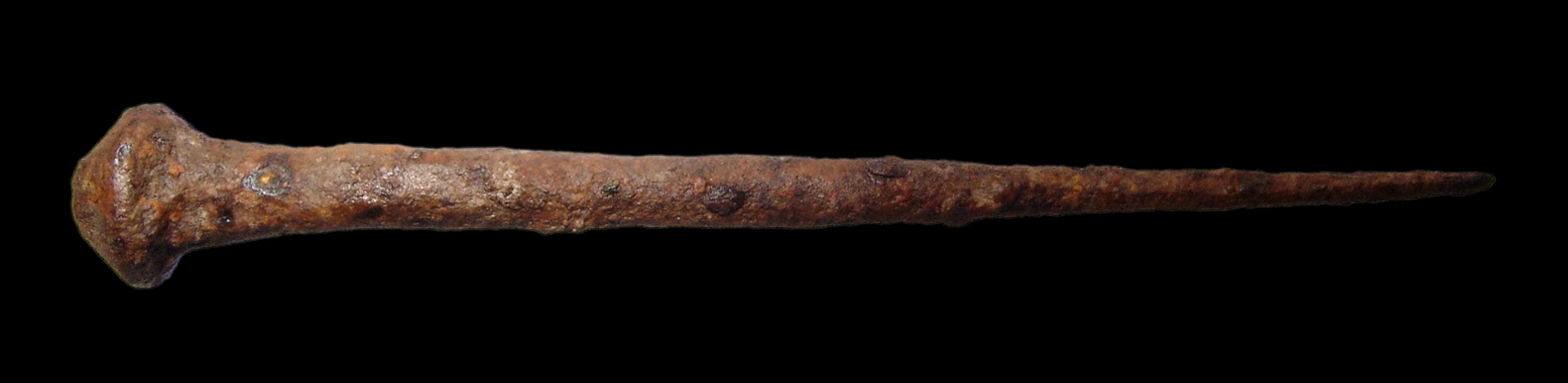
crucifixion nail

Once at the crucifixion site, the execution detail stripped off the clothing of the victims; forced them down to the ground in their open wounds; and were affixed to the patibulum by nails and possibly supported with ropes. The patibulum was then fitted onto the upright stipes where the job was finished by nailing their feet to the stipes.

Crucifixion victims shredded by flogging were faced with enduring a humiliating and slow death. Suffering included severe dehydration, exposure and unspeakable pain.

Each breath caused more excruciating pain, the consequence of hanging by extended arms. The victim had to push up full body weight on nailed feet which, at the same time, pulled at the nail wounds driven through nerves in the wrists.

Hypothermia would have added to the misery. The average of 59° April temperature in Jerusalem ranged from lows as far down as 49°F to highs in the 70s°F.[5]

Exposure was compounded by wind chill, moisture from blood and sweat, and the severe injuries inflicted by scourging and being nailed to the cross. Gospels accounts report Peter warming by a fire in the courtyard the night of the trial and the crucifixion of Jesus began in the morning around 9:00am. 

As if the physical torture wasn’t enough, there was the mental torment of humiliation by being stripped of clothing and hanging from the cross at a high traffic location as a spectacle for staring passers-by who, along with the Roman soldiers, shouted insults at the victim. Hanging defenseless, bloodied and fully exposed on the cross, the sufferer was subject to becoming living carrion for scavenging animals and birds.

Victims most likely died from hypovolemic shock (blood circulation complications) or a combination of other factors.[6] Death was believed to be hastened by breaking the legs of the victim such as mentioned in the Gospel accounts of the two thieves crucified with Jesus.

Roman judicial crucifixions were overseen by an execution squad consisting of a centurion, exactor mortis, and four soldiers known as a quaternion.[7] In charge of the execution, the centurion was responsible for reporting back to the governing authority when the execution had been completed.[8] Failure to complete his duty could have dire consequences – survival of a crucifixion victim was not an option.[9]

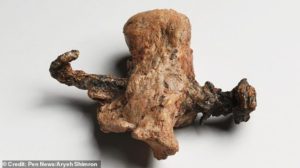
crucifixion nail & heel bone

Archeological evidence of a crucifixion was found in an ancient cemetery excavated in 1968 by Vassilios Tzaferis of the Israel Department of Antiquities.[10] Pottery shards in the tomb dated to the period that followed King Herod’s dynasty up to 70 AD.

One adult male’s remains, those of “Yehohanan, the son of Hagakol,” were identified by anthropologists to have died by crucifixion, his heel bone pierced by a bent 4.5 inch nail. Remains of the olive wood cross were still attached between the nail bend and the heel bone as well as a remnant of the acacia or pistacia wooden plaque between the head of the nail and outside of the heel bone. The lower leg bones had been splintered by a sharp blow.

Forensic, pathology, and medical research; antiquity historical references; an archeological discovery and anthropology research all remarkably corroborate the circumstances of the crucifixion details in the Gospel accounts.

Considering the scientific information that substantiates historical references, how believable are the Gospel accounts saying that Jesus of Nazareth died by means of crucifixion ?


Updated January 25, 2026.

Creative Commons License
This work is licensed under a Creative Commons Attribution-NonCommercial-NoDerivatives 4.0 International License.

REFERENCES:

Gospel accounts of the crucifixion of Jesus:  Matthew 27:26-56; Mark 15:15-41; Luke 23:20-49; John 19:1-35.

[1] Shah, Zia.  “Jesus did not die on the cross!” For Christians, To be Born Again in Islam!  2012.  <https://islamforwest.org/article/jesus-did-not-die-on-the-cross rel=”nofollow”>  Quran 4:157, Pickthall translation.  <http://www.islam101.com/quran/QTP/index.htm > Hill, Kate, “The Physical Death of Jesus Christ: The “Swoon Theory” and the Medical Response.” 2015. Providence College.  <http://digitalcommons.providence.edu/cgi/viewcontent.cgi?article=1000&context=faith_science_2015>  Samuelsson, Gunnar.  Crucifixion in Antiquity.  2011.  Tübingen, Germany: Mohr Siebeck.  <https://www.academia.edu/4167205/Crucifixion_in_Early_Christianityrel=”nofollow”>
[2] “excruciating.”   Dictionary.com.  2017.  <http://www.dictionary.com>   “crucifixion.”  Merriam-Webster.  2017 <http://www.merriam-webster.com>
[3] Cicero. Secondary Orations Against Verres, Book 5, Chapter LXVI.   Zias, Joe.  Joe.Zias.com. “Crucifixion in Antiquity – The Anthropological Evidence.” 2009. Archive.org. <http://web.archive.org/web/20121211060740/http://www.joezias.com/CrucifixionAntiquity.html>  Josephus, Flavius.  The Life of Flavius Josephus. #75. Google Books. n.d.  <http://books.google.com/books?id=e0dAAAAAMAAJ&printsec=frontcover&source=gbs_ge_summary_r&cad=0#v=onepage&q&f=false
[4] Edwards, William D.; Gabel,Wesley J.; Hosmer, Floyd E. The Journal of the American Medical Association. “On The Physical Death of JesusChrist.” March 21, 1986, Volume 256 <http://hopechurchonline.net/pdf/JAMA_article_The_Crucifixion_of_Jesus_Christ.pdf>  Zugibe, Frederick T., PhD. E-Forensic Medicine. “Turin Lecture:  Forensic and Clinical Knowledge of the Practice of Crucifixion.” 2005. <http://web.archive.org/web/20130925103021/http://e-forensicmedicine.net/Turin2000.htm>  Cilliers, L. & Retief F. P.  U.S. National Library of Medicine|National Institute of Health. “The history and pathology of crucifixion.” Dec;93(12):938-41.  <http://www.ncbi.nlm.nih.gov/pubmed/14750495>   Maslen and Mitchell. Journal of the Royal Society of Medicine. “Medical theories on the cause of death in crucifixion.” 2006. <http://www.ncbi.nlm.nih.gov/pubmed/14750495
[5] “Weather in April in Jerusalem.” Climatemps.com. <http://www.jerusalem.climatemps.com/april.php>   “Jerusalem.”  HolidayWeather.com. <http://www.holiday-weather.com/jerusalem/averages/april>   McCullough, Lynne, M.D. and Arora, Sanjay, M.D.  AAFP.org. 2004 Dec 15. http://www.aafp.org/afp/2004/1215/p2325.html>  Li, James, M.D. “Hypothermia.” Sep 09, 2016. <http://emedicine.medscape.com/article/770542-overview#a5>  “Ancient Roman “Crucifixion Spike” 1st – 2nd Century AD.” Ancient Resource. photo. 2020. <http://www.ancientresource.com/lots/roman/crucifixion-nails-spikes.html
[6] Cilliers & Retief.  “The history and pathology of crucifixion.”  Zugibe. “Turin Lecture – Forensic and Clinical Knowledge of the Practice of Crucifixion.”  Maslen and Mitchell. “Medical theories on the cause of death in crucifixion.”  Alchin, Linda.  Tribunes and Triumphs. “Roman Crucifixion.” 2008. <http://www.tribunesandtriumphs.org/roman-life/roman-crucifixion.htm>  Zias. “Crucifixion in Antiquity – The Anthropological Evidence.”  Champlain, Edward.   Zugibe. “Turin Lecture – Forensic and Clinical Knowledge of the Practice of Crucifixion.”  Geberth, Vernon J. “State Sponsored Torture in Rome: A Forensic Inquiry and Medicolegal Analysis of the Crucifixion of Jesus Christ.” 2012. Reprint: AAFS Proceedings Annual Scientific Meeting Washington, D.C. February 18-23.  pp 176-177. 2008. <https://r.search.yahoo.com/_ylt=AwrNZs.XOMplcmMnC3wPxQt.;_ylu=Y29sbwNiZjEEcG9zAzEEdnRpZAMEc2VjA3Ny/RV=2/RE=1707780375/RO=10/RU=http%3a%2f%2fwww.practicalhomicide.com%2fResearch%2fRome2012.doc/RK=2/RS=c4KuoiEJ.qGr7k28di3AscjU6i0-> Champlain, Edward. Nero. Harvard University Press. p 1222009. <https://books.google.com/books?id=30Wa-l9B5IoC&lpg=PA122&ots=nw4edgV_xw&dq=crucifixion%2C%20tacitus&pg=PP1#v=onepage&q&f=false>  Champlain, Edward. Nero. Harvard University Press. p 122. 2009. <https://books.google.com/books?id=30Wa-l9B5IoC&lpg=PA122&ots=nw4edgV_xw&dq=crucifixion%2C%20tacitus&pg=PP1#v=onepage&q&f=false>
[7] Zugibe. “Turin Lecture – Forensic and Clinical Knowledge of the Practice of Crucifixion.
[8] Santala, Risto. The Messiah In The New Testament In The Light Of Rabbinical Writings. Trans. William Kinnaird. “Jesus Before The Representatives of the Roman State.”  1993.  <http://www.kolumbus.fi/risto.santala/rsla/Nt/index.html>   Swete, Henry Barclay.  The Gospel According to St. Mark, The Greek Text with Notes and Indices. 1902.  Google Books.  <https://books.google.com/books?id=WcYUAAAAQAAJ&lpg=PA127&ots=f_TER300kY&dq=Seneca%20centurio%20supplicio%20pr%C3%A6positus&pg=PP1#v=onepage&q&f=false
[9] Seneca, Lucius Annaeus. “Seneca’s Essays Volume I.”  Moral Essays. Book III. “To Novatus on Anger+.” Book I.  The Stoic Legacy to the Renaissance.  <http://www.stoics.com/seneca_essays_book_1.html#ANGER1>   Josephus, Flavius.  Wars of the Jews.  Book VI, Chapter IV,  Chapter VII.  Google Books. n.d. <http://books.google.com/books?id=e0dAAAAAMAAJ&printsec=frontcover&source=gbs_ge_summary_r&cad=0#v=onepage&q&f=false>  Shimron, Aryeh. The U.S. Sun. 2022. photo. Last accessed 12 Sept. 2022. <https://www.the-sun.com/news/1672868/nails-crucify-jesus-fragments-bone/#
[10] Shanks, Hershel.  “Crucifixion Bone Fragment, 21 CE.”  The Center for Online Judaic Studies. 2004.  <http://cojs.org/crucifixion_bone_fragment-_21_ce>  Tzaferis, Vassilios. Bible Archaeology Society. “Crucifixion – the Archaelogical Evidence.” n.d. <https://www.biblicalarchaeology.org/daily/biblical-topics/crucifixion/a-tomb-in-jerusalem-reveals-the-history-of-crucifixion-and-roman-crucifixion-methods