Jeremiah – (Don’t Kill) the Messenger


Jeremiah was tasked by God to foretell news to kings and people of Jerusalem at a time when it was not uncommon to kill the messenger if the news was not welcome.[1] It didn’t matter that sprinkled in were reassuring prophecies of good news about the coming Messiah and the regathering the nation of the Hebrews.

While Josiah was king of Judah, Jeremiah foretold Jerusalem would meet the judgement of total destruction – captives, many killed and treasures lost. The Hebrew people had willfully and repeatedly broken the Covenant they agreed to uphold when God gave it to them at Mt. Sinai.[2]

Death plots, even by his own family, were orchestrated to kill Jeremiah.[3] Passhur, chief of security for the priests, had Jeremiah flogged and put in stocks near the Temple.[4]

Released the next day, Jeremiah foretold to Passhur of the manner of his death and that of his family and friends. Specifically, “the king of Babylon” would strike them with terror.[5]

Continuing their defiance and evil ways, such as having sex with pagan gods and sacrificing their own children to them, drew the wrath of God setting the scene for the curse of Jeconiah (aka Jehoiachin).[6] God sent a judgement message through Jeremiah to both Jeconiah and his father King Jehoiakim, son of Josiah.

For Jehoaikim, it was a death sentence. As for Jechoniah. none of his sons would sit on the throne of David nor would they even prosper.[7]

Just five verses later, Jeremiah makes clear that in-spite-of God’s judgement, David’s royal lineage would not end.[8] God explicitly promised another King would be raised up from the Branch of David:

Jer 23:5 ”Behold, the days are coming,” declares the LORD, “When I will raise up for David a righteous Branch; And He will reign as king and act wisely And do justice and righteousness in the land.”(NASB)

Nebuchadnezzar’s Babylonian army attacked Jerusalem fulfilling the judgement prophecy by wreaking havoc and destruction on Jerusalem while taking captives.[9] One of those captives with special skills and pedigree was indeed King Jeconiah as well as another future high-profile Biblical figure – Daniel.[10]

Over the next 10 years Nebuchadnezzar’s puppet King Zedekiah, brother of Jeconiah, had learned nothing from the judgment of his father and brother by continuing to ignore and offend both King Nebuchadnezzar and God.[11] Having had enough, King Nebuchadnezzar took action against Jerusalem once again.

Meanwhile, Irijah, captain of the Guards in Jerusalem, accused Jeremiah of being a traitor and then had him arrested, tried, flogged and thrown into a dungeon.[11] Jeremiah’s nemesis, Pashhur, along with three others approached Zedekiah advising the King that the prophet should be killed because his prophecies were demoralizing the troops.[12]

Zedekiah allowed Pashhur and his cohorts to do as they wanted. Consequently, they lowered Jeremiah into an old cistern, deep with mud, and left him to starve to death.[13]

Ebed Melech, an Ethiopian official at the palace, heard of Jeremiah’s plight. While King Zedekiah was conducting royal business at the Benjamin Gate away from the strict protocols of the palace, Ebed took the opportunity to inform the King of Jeremiah’s situation.

Quietly King Zedekiah instructed Ebed how to secretly rescue the prophet from the cistern. Jeremiah was moved to an outdoor prison yard and given a scant daily ration of bread.[14]

Puppet King Zedekiah came to realize the truthfulness of Jeremiah’s prophecies when Nebuchadnezzar again besieged Jerusalem. Zediakiah secretly questioned the prophet seeking his guidance, but it was too late.[15]

During his confinement God sent another message to Jeremiah to address worries that God had rejected Israel and Judah saying the throne of David would never end. Jeremiah foretold that the nations would one day be regathered and restored, then issued a second Branch of David prophecy:

Jer. 33:14-15, 17 “‘The days are coming,’ declares the LORD, ‘when I will fulfil the gracious promise I made to the house of Israel and to the house of Judah.  In those days and at that time I will make a righteous Branch sprout from David’s line; he will do what is just and right in the land… For thus says the LORD, ‘David shall never lack a man to sit on the throne of the house of Israel…” (NASB)

Emphasized were the trustworthiness of Jeremiah’s prophecies of God’s promises to Israel and Judah as well as His promises to Abraham, Isaac, Jacob and David. It was not just a promise with a limited guarantee or a warranty – God said it was unconditionally ironclad using an analogy of astronomy:

Jer. 33:20-21 “”Thus says the LORD, ‘If you can break My covenant for the day and My covenant for the night, so that day and night will not be at their appointed time, then My covenant may also be broken with David My servant so that he will not have a son to reign on his throne, and with the Levitical priests, My ministers.” (NASB)

When Babylon attacked, Zedekiah was given a choice:  live, or fight and die. Choosing to surrender to the Babylonians, Zedekiah still tried to escape Nebuchadnezzar’s army, was captured and tortured.[16]

Jeremiah’s reputation as a prophet had become known to the Babylonian King. Remaining imprisoned in the court yard during the siege, Jeremiah was rescued by the command of none other than King Nebuchadnezzar!

Orders issued by Nebuchadnezzar to his top commander, Nebuzaradan, was to find the prophet during their attack of Jerusalem, protect him and do whatever he asked. Jeremiah was released in Gedaliah, given food and a gift.[17]

The Book of Jeremiah issued numerous detailed prophecies, many that came true in a single lifetime. Are the future Branch promises of God issued through Jeremiah reliable prophecies about the Messiah and the regathering of Judah and Israel back in Jerusalem?


Updated January 23, 2026.


Creative Commons License
This work is licensed under a Creative Commons Attribution-NonCommercial-NoDerivatives 4.0 International License.

REFERENCES:

[1] Jeremiah 1; 37:17.
[2] Jeremiah 3:6; chapters 1-15.
[3] Jeremiah 11-12.
[4]Jeremiah 17-18, 20, 26.
[5] Jeremiah 20:4-6. “Jehoiakim.” Jewish Encyclopedia. 2011. <http://jewishencyclopedia.com/articles/8562-jehoiakim>  “Jehoiachin.” Jewish Encyclopedia. 2011. <http://jewishencyclopedia.com/articles/8543-jeconiah>
[6] CR II Chronicles 36:11-14; Jeremiah 3:2; 7:22-26, 31.
[7] CR Jeremiah 36:30-32.
[8] Jeremiah 24; 29; Daniel 1:4.
[9] Daniel 1.
[10] Chronicles 36:12; Jeremiah 27:20; 32:2; 37:1-2.  Bakon, Shimon. “Zedekiah: The Last King of Judah.” Jewish Bible Quarterly. Vol. 36, No. 2, 2008.   <http://jbq.jewishbible.org/assets/Uploads/362/362_zedekiah.pdf>
[11] Jeremiah 37:13-16; 38:6, 13, 24-28.
[12] Jeremiah 38:1-6.
[13] Jeremiah 14:3; 38:5-6, 9.  “Jeremiah in the Cistern.” HeartofaReadyHeart. Image. 2009. <http://heartofareadywriter.blogspot.com/2009/10/august-27th-prophet-persecuted.html
[14] Jeremiah 37:21; 39:16-18.
[15] Jeremiah 37:17; 38:14. CR 37:3-10.
[16] Jeremiah 38:17.
[17] Jeremiah 39; 40; 43:6.

Death Wound of the Messiah


Zechariah authored his prophetic book about the same time Zerubbabel led the Jews from Persia back to Jerusalem to rebuild the city and the Temple destroyed by Nebuchadnezzar. Setting the historical familial context, Zerubbabel, was the grandson of Jeconiah, the last sitting king in the House of David,

Recognized as a prophecy by both Jewish and Christian authorities alike is Zechariah 12:10 – with a few twists. Within each of their own Jewish ranks are differing views about the meaning of the verse.

An interesting debate that had taken place about the meaning of the verse among the Rabbis hundreds of years earlier. Initially, the rabbinic discussion focused on the topic of lust – whether men and women should be separated during worship and mourning services.

Rabbi R. Judah expressed through a question asking if the verse meant the Holy One would slay the Evil Inclination in the presence of both the righteous and the wicked during the Messianic age. The Rabbi’s question changed the discussion:

Sukkah 52a:

“What is the cause of the mourning?

“R. Dosa and the Rabbis differ on the point.  One explained, The cause is the slaying of Messiah the son of Joseph, and the other explained, The cause is the slaying of the Evil Inclination. “It is well according to him who explains that the cause is the slaying of Messiah the son of Joseph, since that well agrees with the Scriptural verse, And they shall look upon me because they have thrust him through, and they shall mourn for him as one mourneth for his only son; “but according to him who explains the cause to be the slaying of the Evil Inclination, is this [it may be objected] an occasion for mourning? Is it not rather an occasion for rejoicing? Why then should they weep?[1]

With that question, the dialog switched direction generating a debate around the prophetic nature of Zechariah 12:10 itself.[2] Jewish sages since then have generally concurred that Zechariah 12:10 refers to the Messiah.

Rabbi Rash, not fully committed, commented in The Complete Jewish Bible with Rashi Commentary:[3]

“…as one mourns over an only son: As a man mourns over his only son. And our Sages expounded this in tractate Sukkah (52a) as referring to the Messiah, son of Joseph, who was slain.” – Rabbi Rashi[4]

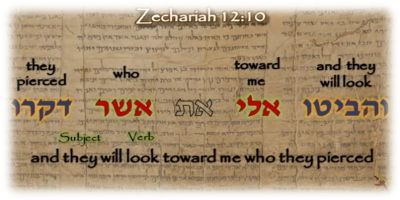
Christian and Hebrew translations pose the biggest controversy centering around one Hebrew word, daqar. Translation of the word as either “pierced” or “thrust him through” is the issue.

Zech. 12:10 “And I will pour upon the house of David, and upon the inhabitants of Jerusalem, the spirit of grace and of supplication; and they shall look unto Me because they have thrust him through; and they shall mourn for him, as one mourneth for his only son, and shall be in bitterness for him, as one that is in bitterness for his first-born.”  – Jewish Publication Society

Zech. 12:10 “And I will pour on the house of David and on the inhabitants of Jerusalem the Spirit of grace and supplication; then they will look on Me whom they pierced. Yes, they will mourn for Him as one mourns for his only son, and grieve for Him as one grieves for a firstborn.” – New King James Version

Jewish Bibles commonly read the Messiah will be “thrust through,” while most Christian Bibles typically translate daqar as pierced, such as by nails.[5] Neither of the interpretations are manifestly consistent with historical scriptural usage of the word.

Good News Translation and God’s Word Translation interprets daqar as “stabbed.” The Message and Contemporary English Version each translate the prophecy as piercing with a spear. Another takes the middle road with Bible in Basic English saying “wounded by their hands.”[6]

Regardless if the Hebrew word is translated as “pierced” or “thrust through,” none of the interpretations clearly solves the dilemma of the manner of how the wound was to be inflicted – by nails or by a weapon? The answer may be found through scriptural language analysis.[7]

Nine other times the Hebrew word daqar appears in the texts of the Old Testament/Tanakh including another appearance of the word in Zechariah.[8] In all instances, daqar is used in the context of wounds inflicted by a type of weapon, such as a sword or spear.

Applying this word usage definition of daqar to Zechariah 12:10, the wound was inflicted by means of a type of weapon. John’s Gospel account of the crucifixion and Resurrection of Jesus of Nazareth describes how he was both pierced by nails and had a spear thrust into his side when he was crucified.[9]

Later, John described the resurrected Jesus who suddenly appeared in a locked room where he invited the doubting Disciple Thomas to touch the healed wounds in his hands, feet and in his side. Taking the offer, the doubtful Thomas exclaimed in an excited utterance , “My Lord and my God!”[10]

Were the Gospel accounts of the Jerusalem crucifixion of Jesus of Nazareth a fulfillment of the Zachariah 12:10 prophecy when the slain Messiah was deeply wounded by means of daqar?


Updated January 20, 2026.

Creative Commons License

This work is licensed under a Creative Commons Attribution-NonCommercial-NoDerivatives 4.0 International License.

REFERENCES:

[1] Sukkah 52a, p 75. <http://www.halakhah.com/rst/moed/16b%20-%20Succah%20-%2029b-56b.pdf>
[2] Sukkah 52a. Halakhah.com. Trans. Soncino Babylonian Talmud. n.d. pp 74-77, footnote #1-3. <http://www.halakhah.com/rst/moed/16b%20-%20Succah%20-%2029b-56b.pdf>
[3] “Rashi (Solomon Bar Isaac).” Jewish Encyclopedia. 2011. <http://www.jewishencyclopedia.com/articles/13862-solomon-b-isaac-rashi>
[4] The Complete Jewish Bible – with Rashi Commentary. Zechariah 12:10. <https://www.chabad.org/library/bible_cdo/aid/16216#showrashi=true>
[5] “daqar.” Lexicon-Concordance Online Bible. n.d. <http://lexiconcordance.com/hebrew/1856.html> Benner, Jeff A. Ancient Hebrew Research Center. “Zechariah 12:10 | “Pierced him” or “Pierced me?”” 2022. <https://www.ancient-hebrew.org/studies-verses/zechariah-12-10-pierced-him-or-pierced-me.htm> Benner, Jeff A. Ancient Hebrew Research Center. Zechariah 12:10. image. 2022. <https://www.ancient-hebrew.org/studies-verses/files/landing_zechariah.png
[6] Contemporary English Verson; Good News Translation; God’s Word translation; Zechariah 12:10. BibleHub.com. 2020. <https://biblehub.com/zechariah/12-10.htm>  The Message; Bible in Basic English. Zechariah 12:10. NetBible.org. 2020. <http://classic.net.bible.org/verse.php?book=Zec&chapter=12&verse=10>
[7] Sapir, Avinoam. LSI Laboratory for Scientific Interrogation, Inc. n.d. <http://www.lsiscan.com/index.htm>  “SCAN – Scientific Content Analysis (Statement Analysis).” Advanced Polygraph. 2011. <http://www.advancedpolygraph.com.au/scan.htm> “Introduction to Text Analysis: About Text Analysis.”  Duke University | Libraries. 2017. <https://guides.library.duke.edu/text_analysis>  “What Is the Definition of Textual Analysis?” Reference.com. 2018. <https://www.reference.com/education/definition-textual-analysis-a95087916fcb24cb> Pfarrer, Mike “What is content analysis?” University of Georgia | Terry College of Business. 2012. <http://www.terry.uga.edu/management/contentanalysis>
[8] “daqar.” NetBible.org. Hebrew text. <http://classic.net.bible.org/search.php?search=hebrew_strict_index:01856>
[9] John 19. NetBible.org. Greek text. Strong. “nusso <3572>”  CR Matthew 27; Mark 15; Luke 23.
[10] John 20.