The Place – Promises at Mt. Sinai
Mt. Sinai, Horeb in Hebrew meaning “desert”, is the place where God gave Moses the 10 Commandments, the Law and additionally other promises. These promises and building upon another, in total five, served as the foundational building blocks for the Messiah.
Abraham, Isaac and Jacob were promised through blessings from God as the place for their descendants to possess. Additionally, at Mt. Sinai God promised to establish a kingdom; the permanent place for His Name to dwell; the exclusive place for Israel to observe the Passover; and the Judgement Seat of Israel.[1]
God did not give a lot of details for the place to the Hebrews. None of these promises, other than they would occur in the land promised to Abraham, were fully understood by the Hebrews who, after 400 years, had just fled the harsh rule of Pharaoh in Egypt, the only life they had ever known.
For a ragtag nation of tens of thousands of former slaves without an army, it seemed like an impossibility. Not fully conceptualized, great faith in these promises were required from the fledgling nation of people.
Doubts and lack of faith by the Exodus generation would cost them from seeing God’s promised land.[2] Yet against all odds, over the coming centuries, these promises became a reality.
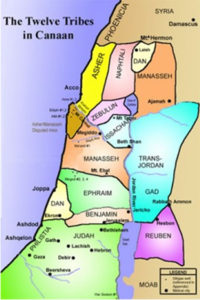 Once entering the land of Abraham, Israel conquered its enemies in the land and each of the 12 tribes of the sons of Israel were allotted their own regions.[3] Now experienced and formidable, this army of Hebrew warriors protected them even before the establishment of a kingdom.
A king, the most famous in Hebrew history, was eventually born in Bethlehem in the lineage of Judah. It fulfilled the prophetic blessing of royalty from Jacob to his son, Judah.
David, the giant-slayer, became King and ruled Israel without a Seat of the Throne until he conquered and occupied the fortified city of Jebus or Salem. Soon thereafter, the city came to be called Jerusalem, also known as Zion, the City of David, and became the capitol of Israel.
A permanent place for the Name of God to dwell required a temple. Fundamental to a theocracy, this temple needed to be located near the king’s throne in the nation’s capital to be protected against heathen enemies.
King Solomon built the Temple at the location on Mt. Moriah his father, David, had chosen. The new Temple was consecrated and blessed by Solomon, the first sacrifice offered at the new Temple on its permanent alter.
Miraculously, the sacrifices were ignited by fire sent down from heaven.[4] Known as Solomon’s Temple, the remnants one wall of the Temple, known as the Western Wall, is one of the most holy places in Israel today.[5]
God’s Law stipulated the Passover was to be celebrated at its appointed time requiring sacrifices to be offered by the priests of God at a central permanent place of worship determined to he the Temple. After the building of the Temple, the Passover was then observed there at its appointed time and the sacrifices were offered by the priests of God.[6]
For a theocratic government, the Judgement Seat also needed to be located in close proximity to both the Throne and its Temple.[7] The most important and most complicated cases of the nation were to be judged in the place God chose.
Jerusalem became the Judgement Seat of Israel under the reign of Solomon where both major civil and criminal cases were decided. In a theocratic government, God’s Law served both as the criminal code and the basis for civil laws.
Civil cases were decided in Jerusalem by King Solomon. These civil cases were decided by the King on the porch of his palace, then later on the east side of the Temple in the Hall of Judgement.[8]
Criminal cases involving the highest level of offenses, including capital death cases, were tried in the Temple Court accessed through the Chamber of Hewn Stone.[9] Built into the northern wall of the Temple, the chamber served as the meeting place for the 70 elders of Israel, eventually known as the Great Sanhedrin.[10]
Because the Hebrews did not honor their Covenant with God as the people had agreed to do at Mt. Sinai, Nebuchadnezzar destroyed and ransacked Jerusalem and the Temple. During the Persian Empire, the Temple was rebuilt under decrees by Cyrus, Darius and Artaxerxes; its gold contents returned, and observance of the annual Passover resumed until Jerusalem was destroyed by Rome in 70 AD.[11]
God’s promises from Mount Sinai laid the ground work for Israel’s future in the place and the foundation of various future Messiah prophecies. Over the coming centuries prophets Isaiah, Zechariah, Jeremiah, Micah and other prophets would give details and expectations about the coming Messiah who would come from the House of David.[12]
All the promises made by God at Mt. Sinai about “the place” came to pass. What are the odds it was all just an extraordinary coincidence?
Updated January 2, 2026.

This work is licensed under a Creative Commons Attribution-NonCommercial-NoDerivatives 4.0 International License.
REFERENCES:
[1] Deuteronomy 1:6-8, 39; 17:8-10, 14. CR Genesis 17, 22, 35, 49; Exodus 19:6; 23:20; Deuteronomy 1:8, 12:11, 16:2, 17:20.
[2] Deuteronomy 1:34-40; Numbers 13, 14:26-35. Wood, Bryant G. BibleArchaeol0gy.org. 2009. “The Number of Israelites in the Exodus.” <https://biblearchaeology.org/research/chronological-categories/exodus-era/3943-the-number-of-israelites-in-the-exodus> “How Many Israelites Really Left Egypt?” JewishBelief.com. n.d. <https://jewishbelief.com/how-many-israelites-left-egypt/>
[3] Deuteronomy 3:12-17. “The Twelve Tribes in Canaan.” Maps Database Source. map. 2020. <https://mapdatabaseinfo.blogspot.com/2018/05/32-map-of-promised-land-joshua.html#
[4] I Chronicles 6; Leviticus 9; Nehemiah 11.
[5] 1 Kings 6; 2 Chronicles 3.
[6] Exodus 12:14-15; Leviticus 23:4-8,; II Chronicles chapters 8, 29, 34-35:19; Ezra 6:16-22. Coulter, Fred R. cbcg.org. The Christian Passover. Chapters 12-13, Part 1. n.d. <https://www.cbcg.org/booklets/the-christian-passover/chapter-twelve-when-and-why-the-temple-sacrifice-of-the-passover-was-instituted-part-one.html> 
[7] Deuteronomy 17:8-10. CR Exodus 18.
[8] 1 Kings 3, 4, 7:7. “Solomon’s Porch.” Encyclopedia of the Bible. n.d. <https://www.biblegateway.com/resources/encyclopedia-of-the-bible/Solomons-Porch> “Solomon’s Porch.” BibleVerseStudy.com. n.d. <https://www.bibleversestudy.com/acts/acts5-solomons-porch.htm> “Temple of Herod.” JewishEncyclopedia.com. 2011. <https://jewishencyclopedia.com/articles/14304-temple-of-herod> “Solomon’s Porch.” Bible-History.com. n.d. <https://bible-history.com/backdrops/solomons-porch>
[9] Schoenberg, Shira. “Ancient Jewish History: The Sanhedrin.” 2017. <http://www.jewishvirtuallibrary.org/the-sanhedrin> Shachter, J. and Freedman, H. Soncino Babylonian Talmud. Ed. Isidore Epstein Introduction. <https://www.halakhah.com/sanhedrin/>
[10] Exodus 18; Deuteronomy 1, 17; II Chronicles 19:8:4-11. Shachter and Freedman. “Introduction to Sanhedrin.” Soncino Babylonian Talmud. <https://israelect.com/Come-and-Hear/sanhedrin/index.html> Ariel, Yisrael. “The Chamber of the Hewn Stone.” The Temple Institute. 2014. <https://www.templeinstitute.org/illustrated/hewn_stone_description.htm> Ariel, Yisrael. “Blueprints for the Holy Temple.” <http://www.templeinstitute.org/blueprints-for-the-holy-temple.htm>
[11] Isaiah 52-53. Sanhedrin 16a, 17a. Shachter, J. and Freedman, H. “Sanhedrin.” Josephus. Antiquities. Book IV, Chapter VIII.14; Book XX, Chapter IX.4. “Ancient Jewish History: The Beit Din.” Jewish Virtual Library. 2017.http://www.jewishvirtuallibrary.org/the-beit-din>
[12] Isaiah 7, 9; 11; Jeremiah 23, 33; Zechariah 3, 6, 12.