The Place – Promises at Mt. Sinai 


Mt. Sinai, Horeb in Hebrew meaning “desert”, is the place where God gave Moses the 10 Commandments, the Law and additionally other promises. These promises and building upon another, in total five, served as the foundational building blocks for the Messiah.

Abraham, Isaac and Jacob were promised through blessings from God as the place for their descendants to possess. Additionally, at Mt. Sinai God promised to establish a kingdom; the permanent place for His Name to dwell; the exclusive place for Israel to observe the Passover; and the Judgement Seat of Israel.[1]

God did not give a lot of details for the place to the Hebrews. None of these promises, other than they would occur in the land promised to Abraham, were fully understood by the Hebrews who, after 400 years, had just fled the harsh rule of Pharaoh in Egypt, the only life they had ever known.

For a ragtag nation of tens of thousands of former slaves without an army, it seemed like an impossibility. Not fully conceptualized, great faith in these promises were required from the fledgling nation of people.

Doubts and lack of faith by the Exodus generation would cost them from seeing God’s promised land.[2] Yet against all odds, over the coming centuries, these promises became a reality.
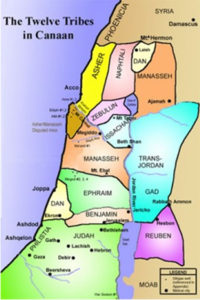
Once entering the land of Abraham, Israel conquered its enemies in the land and each of the 12 tribes of the sons of Israel were allotted their own regions.[3] Now experienced and formidable, this army of Hebrew warriors protected them even before the establishment of a kingdom.

A king, the most famous in Hebrew history, was eventually born in Bethlehem in the lineage of Judah. It fulfilled the prophetic blessing of royalty from Jacob to his son, Judah.

David, the giant-slayer, became King and ruled Israel without a Seat of the Throne until he conquered and occupied the fortified city of Jebus or Salem. Soon thereafter, the city came to be called Jerusalem, also known as Zion, the City of David, and became the capitol of Israel.

A permanent place for the Name of God to dwell required a temple. Fundamental to a theocracy, this temple needed to be located near the king’s throne in the nation’s capital to be protected against heathen enemies.

King Solomon built the Temple at the location on Mt. Moriah his father, David, had chosen. The new Temple was consecrated and blessed by Solomon, the first sacrifice offered at the new Temple on its permanent alter.

Miraculously, the sacrifices were ignited by fire sent down from heaven.[4] Known as Solomon’s Temple, the remnants one wall of the Temple, known as the Western Wall, is one of the most holy places in Israel today.[5]

God’s Law stipulated the Passover was to be celebrated at its appointed time requiring sacrifices to be offered by the priests of God at a central permanent place of worship determined to he the Temple. After the building of the Temple, the Passover was then observed there at its appointed time and the sacrifices were offered by the priests of God.[6]

For a theocratic government, the Judgement Seat also needed to be located in close proximity to both the Throne and its Temple.[7] The most important and most complicated cases of the nation were to be judged in the place God chose.

Jerusalem became the Judgement Seat of Israel under the reign of Solomon where both major civil and criminal cases were decided. In a theocratic government, God’s Law served both as the criminal code and the basis for civil laws.

Civil cases were decided in Jerusalem by King Solomon. These civil cases were decided by the King on the porch of his palace, then later on the east side of the Temple in the Hall of Judgement.[8]

Criminal cases involving the highest level of offenses, including capital death cases, were tried in the Temple Court accessed through the Chamber of Hewn Stone.[9] Built into the northern wall of the Temple, the chamber served as the meeting place for the 70 elders of Israel, eventually known as the Great Sanhedrin.[10]

Because the Hebrews did not honor their Covenant with God as the people had agreed to do at Mt. Sinai, Nebuchadnezzar destroyed and ransacked Jerusalem and the Temple. During the Persian Empire, the Temple was rebuilt under decrees by Cyrus, Darius and Artaxerxes; its gold contents returned, and observance of the annual Passover resumed until Jerusalem was destroyed by Rome in 70 AD.[11]

God’s promises from Mount Sinai laid the ground work for Israel’s future in the place and the foundation of various future Messiah prophecies. Over the coming centuries prophets Isaiah, Zechariah, Jeremiah, Micah and other prophets would give details and expectations about the coming Messiah who would come from the House of David.[12]

All the promises made by God at Mt. Sinai about “the place” came to pass. What are the odds it was all just an extraordinary coincidence?


Updated January 2, 2026.

Creative Commons License

This work is licensed under a Creative Commons Attribution-NonCommercial-NoDerivatives 4.0 International License.

REFERENCES:
[1] Deuteronomy 1:6-8, 39; 17:8-10, 14. CR Genesis 17, 22, 35, 49; Exodus 19:6; 23:20; Deuteronomy 1:8, 12:11, 16:2, 17:20.
[2] Deuteronomy 1:34-40; Numbers 13, 14:26-35.  Wood, Bryant G. BibleArchaeol0gy.org. 2009. “The Number of Israelites in the Exodus.” <https://biblearchaeology.org/research/chronological-categories/exodus-era/3943-the-number-of-israelites-in-the-exodus> “How Many Israelites Really Left Egypt?” JewishBelief.com. n.d. <https://jewishbelief.com/how-many-israelites-left-egypt/>
[3] Deuteronomy 3:12-17.  “The Twelve Tribes in Canaan.” Maps Database Source. map. 2020. <https://mapdatabaseinfo.blogspot.com/2018/05/32-map-of-promised-land-joshua.html#
[4] I Chronicles 6; Leviticus 9; Nehemiah 11.
[5] 1 Kings 6; 2 Chronicles 3.
[6] Exodus 12:14-15; Leviticus 23:4-8,; II Chronicles chapters 8, 29, 34-35:19; Ezra 6:16-22. Coulter, Fred R. cbcg.org. The Christian Passover. Chapters 12-13, Part 1. n.d. <https://www.cbcg.org/booklets/the-christian-passover/chapter-twelve-when-and-why-the-temple-sacrifice-of-the-passover-was-instituted-part-one.html>&nbsp
[7] Deuteronomy 17:8-10. CR Exodus 18.
[8] 1 Kings 3, 4, 7:7.  “Solomon’s Porch.” Encyclopedia of the Bible. n.d. <https://www.biblegateway.com/resources/encyclopedia-of-the-bible/Solomons-Porch>  “Solomon’s Porch.” BibleVerseStudy.com. n.d. <https://www.bibleversestudy.com/acts/acts5-solomons-porch.htm>  “Temple of Herod.” JewishEncyclopedia.com. 2011. <https://jewishencyclopedia.com/articles/14304-temple-of-herod> “Solomon’s Porch.” Bible-History.com. n.d. <https://bible-history.com/backdrops/solomons-porch>
[9] Schoenberg, Shira. “Ancient Jewish History: The Sanhedrin.” 2017. <http://www.jewishvirtuallibrary.org/the-sanhedrin>   Shachter, J. and Freedman, H. Soncino Babylonian Talmud. Ed. Isidore Epstein Introduction. <https://www.halakhah.com/sanhedrin/>
[10] Exodus 18; Deuteronomy 1, 17; II Chronicles 19:8:4-11.  Shachter and Freedman.  “Introduction to Sanhedrin.”  Soncino Babylonian Talmud. <https://israelect.com/Come-and-Hear/sanhedrin/index.html>  Ariel, Yisrael. “The Chamber of the Hewn Stone.” The Temple Institute. 2014. <https://www.templeinstitute.org/illustrated/hewn_stone_description.htm>  Ariel, Yisrael. “Blueprints for the Holy Temple.”  <http://www.templeinstitute.org/blueprints-for-the-holy-temple.htm>
[11] Isaiah 52-53. Sanhedrin 16a, 17a. Shachter, J. and Freedman, H.  “Sanhedrin.” Josephus.  Antiquities. Book IV, Chapter VIII.14; Book XX, Chapter IX.4. “Ancient Jewish History: The Beit Din.” Jewish Virtual Library. 2017.http://www.jewishvirtuallibrary.org/the-beit-din>
[12] Isaiah 7, 9; 11; Jeremiah 23, 33; Zechariah 3, 6, 12.

The Gospels – Just Recycled Material?


Similarities between certain passages of one Gospel found in another, sometimes word for word, are eyebrow-raising characteristics. They fuel conspiracy theories saying this is evidence of Christian collaborators making up a Messiah story.

Matthew, Mark and Luke – called the Synoptic Gospels – contain “parallel passages” where content similarities typically appear.[1] On full display in the synoptic Gospels is the distinctive Jewish literary practice of grouping content by topic instead of chronologically.[2]

In literary circles of Antiquity, written materials were considered communal property available to be freely used by other literati with or without citations.[3] The Synoptics use of a common source or sources is actually a reflection of legitimate writing protocol of the times.[4]

Excellent points of comparison are the major Jewish works written during the same era. They include Josephus, the Talmud Mishnah, and other New Testament books.[5]

Most authorities agree the Gospel of John is an authentic eyewitness account written independently of the Synoptic Gospels though it serves as a calibration source.[6] Writing that he did not intend to cover all the things Jesus had done, still some critics use John’s omission of events found in the other three Gospels to challenge his credibility.[7]

Luke’s author openly acknowledged using “handed down” information, a practice common to Jewish and other cultures and Rabbi sages “handed down” oral interpretations of the Law over many generations until committed to writing in the Talmud.[8] Josephus wrote that he used expert sources “for the proof of what I say” in support of his writings.[9]

Jewish literary works used quotations as a means to cite sources in a time before footnotes or end notes came into existence.[10] Throughout the New Testament, quotations of the Jewish Scripture Septuagint translation can be seen preceded by the phrase “it is written.” Quoting was also a practice also used in the Talmud and by Josephus.[11]

Literary authenticity and integrity, Josephus wrote, could be achieved by following the role model of Moses who took unexciting legal topics and made them meaningful and understandable while not adding or taking anything away.[12] Moses took the source material of God’s Law handed down to him at Mt. Sinai and committed it to writing while interweaving it with factual, interesting Hebrew stories thereby producing a distinct literary work.[13]

Unique qualities found through simple literary analysis are obvious at the beginning of each Gospel.[14] Matthew, written for a Jewish audience, starts the genealogy of Jesus with Abraham. while the author of Luke, written to a Gentile audience, worked the genealogy of Jesus backward to Adam.[15]

Mark begins by immediately declaring Jesus to be the Son of God, then ties a prophecy to his introduction of John the Baptist. John’s well-known opening says “In the beginning was the Word, and the Word was with God, and the Word was God.”[16]

Quantifying the differences through deeper literary analysis, over 35% of the content of Matthew is unique to the Synoptics – not found in Mark or Luke.[17] Nearly 50% of the verses in Luke are not common to either Matthew or Mark.[18] Slightly less than 40% of the content of Mark is not shared by Matthew and Luke while nearly 8% of Mark is completely unique content.[19]

A fascinating characteristic of authenticity is demonstrated through miracles and parables. Contrary to popular perceptions, the Synoptics have less in common among the Gospels than they have in common.

Of the 35 miracles recorded in the Gospels, only one is common to all four – the feeding of the 5000. One of the most, if not the most, famous miracle is Jesus walking on water and it does not appear in Luke![20]

Only 10 miracles, less than a third, are common to all three Synoptic Gospels. Almost half, 16 in all, are uniquely reported by a given author – 3 by Matthew, 2 by Mark, 5 by Luke and 6 by John.

Parables can be tricky to quantify (was it an illustration or a parable?) so the lists vary somewhere in the range of 30.[21] Only 5-7 of the parables are common to all three Synoptics.[22] Instead, about 70% of the parables are unique to either Matthew or Luke alone; Matthew having 10-12 and Luke with 15-17 while just one parable is exclusive to Mark and John does not recount any.[23]

Gospel authors produced literary works about Jesus of Nazareth that are distinctive yet corroborating. Are the Gospels no more than recycled information or do they meet the standard of literary authenticity?


Updated February 2026.

Creative Commons License

This work is licensed under a Creative Commons Attribution-NonCommercial-NoDerivatives 4.0 International License.

REFERENCES:

[1] Smith, Ben C. “Gospel manuscripts.” <http://www.textexcavation.com/gospelmanuscripts.html> Gloag, Paton J.  Introduction to the Synoptic Gospels. Page 5. <http://catalog.hathitrust.org/Record/008728595 “Synoptic Gospels.” Theopedia.com. <http://www.theopedia.com/Synoptic_Gospels “The Book of Matthew.” Quartz Hill School of Theology. http://www.theology.edu/biblesurvey/matthew.htm Mareghni, Pamela. “Different Approaches to Literary Criticism.” <http://web.archive.org/web/20140628042039/http://www.ehow.com/about_5385205_different-approaches-literary-criticism.html >
[2] Reed, Annette Yoshiko.  Pseudepigraphy, Authorship, and ‘The Bible’ in Late Antiquity. Pages 478 – 489. <http://www.academia.edu/1610659/_Pseudepigraphy_Authorship_and_the_Reception_of_the_Bible_in_Late_Antiquity>  Last accessed 9 May 2014.  Gloag, Introduction to the Synoptic Gospels.  Pages 9, 23-38. <http://catalog.hathitrust.org/Record/008728595>
[3] Josephus, Flavius.  Against Apion.  Book I. <http://books.google.com/books?id=e0dAAAAAMAAJ&printsec=frontcover&source=gbs_ge_summary_r&cad=0#v=onepage&q&f=false>   “Custom Cheating and Plagiarism essay paper writing service.” <http://exclusivepapers.com/essays/Informative/cheating-and-plagiarism.php>  Cummings, Michael J. “Did Shakespeare Plagiarize?” <http://cummingsstudyguides.net/xPlagiarism.html>
[4] Gloag, Introduction to the Synoptic Gospels. Pages 50-51.
[5] “Josephus, Flavius.” JewishEncylopedia.com.  <http://www.jewishencyclopedia.com/articles/8905-josephus-flavius>  Maimonides, Moses.  Mishneh Torah. “Introduction to Mishneh Torah.”  <http://www.chabad.org/library/article_cdo/aid/682956/jewish/Mishneh-Torah.htm>   A Translation of the Treatise Chagigah from the Babylonian Talmud.  Glossary:  “Mishnah.:  Ed. A. W. Streane.  <http://www.archive.org/stream/translationoftre00streuoft/translationoftre00streuoft_djvu.txt>  Segal, Eliezer.  A Page from the Babylonian Talmud.  “The Mishnah” and “The Gemara (Talmud).” <http://people.ucalgary.ca/~elsegal/TalmudPage.html#Page>  Spiro, Ken.  “History Crash Course #39: The Talmud.” Aish.com. 4 Aug. 2001.<http://www.aish.com/jl/h/cc/48948646.html>   Valentine, Carol A. “The Structure of the Talmud Files.” <http://come-and-hear.com/structure.html>  Chase, Jeffrey S. “The Gutenberg Printing Press.” <http://www.cs.duke.edu/~chase/cps49s/press-summary.html>
[6] “Gospel of John.”  Theopedia.com.  <http://www.theopedia.com/Gospel_of_John>  “The Book of John.” Quartz Hill School of Theology. http://www.theology.edu/biblesurvey/john.htm> Smith, Barry D. “The Gospel of John.”  <http://www.mycrandall.ca/courses/NTIntro/John.htm>
[7] John 20:30.
[8] Maimonides, Moses.  Mishneh Torah.  <http://www.chabad.org/library/article_cdo/aid/682956/jewish/Mishneh-Torah.htm>   Chase. “The Gutenberg Printing Press.”  Josephus.  Against Apion. Book I, #6-7.
[9] Josephus. Against Apion. Book I.
[10] Pearse, Roger, ed. “Tacitus and his manuscripts.”  <http://www.tertullian.org/rpearse/tacitus>  “Septuagint.”  Mercer Dictionary of the Bible. <http://books.google.com/books?id=goq0VWw9rGIC&lpg=PA185&ots=D1F_d2-T6T&dq=stipes%2C%20crucifixion&pg=PA185#v=onepage&q=septuagint&f=false>
[11] Josephus.  Against Apion. Book I.  Reed.  Pseudepigraphy, Authorship, and ‘The Bible’ in Late Antiquity.  Chase. “The Gutenberg Printing Press.” Fausset, Andrew R.  “New Testament.”  Fausset Bible Dictionary. <http://classic.studylight.org/dic/fbd>  Irenaeus of Lyons.  Against Heresies. Book III. Chapter XXI.3, also XXI.2.  <http://www.ccel.org/ccel/schaff/anf01.ix.iv.html>  “Septuagint.”  Septuagint.net. 2014.  <http://septuagint.net>  Josephus, Flavius.  Antiquities of the Jews. Book XII, Chapter II.1-6, 13-1.  <http://books.google.com/books?id=e0dAAAAAMAAJ&printsec=frontcover&source=gbs_ge_summary_r&cad=0#v=onepage&q&f=falseThe Babylonian Talmud. Rodkinson translation. Book 4, Tracts Megilla Chapter I. <http://www.sacred-texts.com/jud/talmud.htm>  Benner, Jeff A. “The Great Isaiah Scroll and the Masoretic Text.” <https://www.ancient-hebrew.org/dss/great-isaiah-scroll-and-the-masoretic-text.htm>  Lundberg, Marilyn J. “The Leningrad Codex. <http://www.usc.edu/dept/LAS/wsrp/educational_site/biblical_manuscripts/LeningradCodex.shtml>   “Septuagint.”  Encyclopædia Britannica. <https://www.britannica.com/topic/Septuagint>
[12] Josephus.  Antiquities of the Jew. “Preface” #3
[13] Carr, A. The Gospel According to Matthew, Volume I.  Page XIX.  <http://books.google.com/books?id=ZQAXAAAAYAAJ&dq=Swete%2C%20The%20Gospel%20According%20to%20St.%20Matthew&pg=PP1#v=onepage&q=Swete,%20The%20Gospel%20According%20to%20St.%20Matthew&f=false>
[14] “The Four Gospels.” <http://www.religionfacts.com/christianity/texts/gospels.htm>
[15] Irenaeus. Against Heresies. Book III.  Chapters I, IX, XXI.   “New Testament.” Jewish Encyclopedia.  <http://www.jewishencyclopedia.com/articles/6821-gospels-the-four>  Gloag, Introduction to the Synoptic Gospels. Pages ix, 39.
[16] NIV, NASB, NRSV, NKJV
[17] “Matthew.”  Easton’s 1897 Bible Dictionary.  <http://www.ccel.org/e/easton/ebd/ebd/T0002400.html#T0002442>  “Gospel of Matthew.”  <http://www.religionfacts.com/gospel-matthew>  Carr. The Gospel Accouding to Matthew, Volume I.  Pages XVIII – XIX.  Gloag, Introduction to the Synoptic Gospels.  Pages 32-33.
[18] “Luke, Gospel according to.”  Easton’s Bible Dictionary.  <http://www.ccel.org/e/easton/ebd/ebd/T0002300.html#T0002332>
[19] “Mark, Gospel according to.”  Easton’s Bible Dictionary.  <http://www.ccel.org/e/easton/ebd/ebd/T0002400.html#T0002421>  Swete, Henry Barclay.  The Gospel According to St. Mark, The Greek Text with Notes and Indices.  Pages XIX, LXXIV.<https://books.google.com/books?id=WcYUAAAAQAAJ&lpg=PA127&ots=f_TER300kY&dq=Seneca%20centurio%20supplicio%20pr%C3%A6positus&pg=PP1#v=onepage&q&f=false>
[20] “Luke.”  Easton’s Bible Dictionary.   Ryrie. Charles C., ed.  Ryrie Study Bible.  “The Miracles of Jesus.” 1978. Aune, Eilif Osten. “Synoptic Gospels.” < https://web.archive.org/web/20171214110423/www.bible-basics-layers-of-understanding.com/Synoptic-Gospels.html >
[21] Sween, Don and Nancy.  “Parable.” BibleReferenceGuide.com.  n.d. <http://www.biblereferenceguide.com/keywords/parable.html>
[22] “Parables” Easton’s Bible Dictionary.  <http://www.ccel.org/e/easton/ebd/ebd/T0002800.html#T0002842> “Luke, Gospel according to.”  Easton’s Bible Dictionary.  “Parables.”  International Standard Bible Encyclopedia. <http://www.internationalstandardbible.com/P/parable.html> Ryrie. “The Miracles of Jesus.”  Aune.  “Synoptic Gospels.”
[23] Smith, B. D. “The Gospel of John”, F. 5.3.3.  Sween.  “Parable.” Swete. The Gospel According to St. Mark, The Greek Text with Notes and Indices. Pages LXXIV, 83.  “Luke, Gospel according to.”  Easton’s Bible Dictionary. “Parable.” International Standard Bible Encyclopedia.  Ryrie. “The Parables of Jesus.”

Balaam’s Prophecy to a King


Mt. Sinai was past, but then the Hebrews spent 40 years of wandering through portions of the Sinai, Negev and Arabian deserts. Delayed by two generations as a consequence of the Hebrew’s lack of faith, a promise from God remained fully in effect:  the Hebrew tribes would be protected from their enemies.[1]

Abraham, Isaac and Jacob had been promised through God’s blessings that many nations and kings would come from their descendants. Jacob divided the blessing among his sons, future fathers of the 12 tribes of Israel.

While promises made at Mt Sinai laid foundational requirements for the Messiah at the place, no particular prophecy pointed directly to the future Messiah. First of the distinctive Messiah prophecies came from a very unlikely source…

Following pillars of cloud by day and fire by night, the Hebrews were on their trek to the place.[2] Standing in the way of the Hebrews was yet another Gentile enemy, Moab,  located east of the Dead Sea in modern day Jordan, ruled by King Balak son of King Zippor.

Balak was painfully aware of how the Hebrews had vanquished the strongly defensed Amorites whose own army had previously defeated Moab and occupied many of its cities. History was poised to repeat itself for Moab, this time at the hands of the Hebrews.[3]

Dread spread throughout Moab for fear of the size and might of the Hebrew people backed by God. Knowing his military was no match for the Hebrews, the King thought that only supernatural intervention from God could save his kingdom.

Rather than asking for God’s guidance and help, the King tried a different strategy; instead, he decided to try to place a curse on the Hebrews. Balak and sent an envoy of Moabite leaders to buy the services of Balaam for that purpose.[4]

Balaam was neither a Hebrew prophet nor even familiar with them. In real time, the encounter between Balak and Balaam was unknown to the Hebrews.

Finding Balaam, an envoy presented the King’s royal request and asked him to take a night to consider it. Praying for guidance that night, God told Balaam not to return to the Balak and not to place a curse on the Hebrews because they were “blessed.”

Following the response from God, Balaam rejected the offer. Returning home, the Moabite envoy informed the King the prophet refused to return with them although it is not stated if Balak was told why Balaam declined his offer.

Undeterred, Balak upped the ante by sending back to the prophet a larger envoy with more distinguished leaders promising Balaan great honors if he would return with them to place a curse on the Hebrews. Balaam told the second envoy that even if he was offered a palace full of silver and gold, he could not do more or less than God’s commandment.

Still, Balaam said he would give the envoy an answer the next morning and that night he again sought God’s guidance. Against God’s instruction, the next day Balaam decided to go with the envoy and meet the King, but their journey was blocked by an angel using a donkey to convey the message.

Balaam became angry with the donkey not moving and, not knowing an angel was blocking its way, beat the donkey and confronted Balaam about it. Confessing he had sinned, Balaam was allowed to continue with God’s strict instructions to say only what He was instructed.

Upon arriving King Balak, who was irritated with Balaam, questioned why the prophet had resisted royal requests to come see him. Brushing off the question and getting right to the point, Balaam said,

Num 22:38 “I have come to you now, but do I have power to say just anything? The word God puts in my mouth, that is what I must say.”(NRSV)

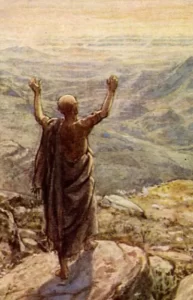
Nevertheless, three times Balak took Balaam to a different high position on a mount  to observe portions of the extensive size of the Hebrew people who could not be seen entirely from one location. On each mount, Balak offered a sacrifice.

After each sacrifice, the King asked the prophet to place a curse on the Hebrews. Each time, Balaam sought God’s message which came back with blessings on the Hebrews rather than a curse.

After the third time, Balak was exasperated. Clapping his hands King Balak said, “I called you to curse my enemies, but behold, you have persisted in blessing them these three times!”[5]

Announcing he was going back home, Balaam said he would foretell Moab’s future before he left.[6] It was a dark prophecy for Moab in the form of an oracle prefaced with a royal prophecy about Israel’s bright future:

Num 24:17 “I see him, but not now; I behold him, but not near; A star shall come forth from Jacob, A scepter shall rise from Israel, And shall crush through the forehead of Moab, And tear down all the sons of Sheth.”(NASB)

According to the renowned Jewish sage, Rabbi Rashi, Balaam’s oracle is a Messiah prophecy. Interpretations by the Rabbi are tied to the blessing of Jacob’s grandfather Abraham promising “kings will come forth from you.”[7]

“Scepter” is translated in the Bible from the Hebrew word shebet, the same word used in Jacob’s royalty blessing of his son, Judah, in Genesis 49:10. Rashi interpreted the term scepter as representing “a king who rules dominantly” from the future lineage of David.

Referring to the star, Rashi expounded it represents one who “shoots out like an arrow” from Jacob and uproots the sons of Sheth or Seth, the son of Adam; in other words, symbolically uproots all of mankind.[8]

If the appearance of Jesus of Nazareth was to be a fulfillment of Balaam’s prophecy, a lot of pieces first had to come together to fulfill the promises made at Mt. Sinai. Hundreds of years into the future, prophets of the Bible would bring clarity to these promises that became requirements setting the stage for the Messiah to be born in the royal lineage of the House of David.

Promises made at Mt. Sinai were fulfilled over time, but one part of Balaam’s prophecy was not yet fulfilled – “A star shall come forth from Jacob.” Was it a symbolic prophecy of someone who would uproot all of mankind or was it a literal prophecy fulfilled by “his star” observed by the Magi signaling the birth of the “King of the Jews”… perhaps both?


Updated January 3, 2026.

Creative Commons License

This work is licensed under a Creative Commons Attribution-NonCommercial-NoDerivatives 4.0 International License.

REFERENCES:

[1] Deuteronomy 2-7; 23:23-31; Number 14:24, 26-35.
[2] Numbers 14. “Sinai Peninsula;” “Negev;” and “King’s Highway.” Encyclopædia Britannica.  2014.  http://www.britannica.com
[3] Numbers 21-22. “Map of OldTestament Israel.”  Bible-history.com.  <http://www.bible-history.com/geography/ancient-israel/israel-old-testament.html> “Israel and Judah.” Free English Site. map. 2017. <http://www.freeenglishsite.com/LDS/other/Moab.htm
[4] Numbers 22. CR Deuteronomy 23:5/6.
[5] NASB. Numbers 24:10. “What is the error of Balaam?” EndoftheMatter.com. image. 2022. <https://i0.wp.com/endofthematter.com/wp-content/uploads/2021/07/BalaamintheBible-171300653-43bf701fd28844c6a5682acf05b9c83a.jpg?fit=1024%2C576&ssl=1>
[6] Numbers 24:20-24.
[7] Gensis 17:6, NASB.
[8] Rashi. The Complete Jewish Bible with Rashi Commentary  Commentary for Numbers 24:17.