Science and the Translation of Psalms 22


One verse in Psalms 22 creates a two-part controversy starting first with its translation difference between Christian and Jewish Bibles. That difference then leads to the next controversy, whether Psalms 22 is a foreshadowing or prophecy that foretells the crucifixion death of the Messiah.[1]

Christian Bible translations of Psalms 22:16 and Jewish Bibles Psalms 22:17 vary significantly. The differences are profound:

PS 22:16 “Dogs have surrounded me; a band of evil men has encircled me, they have pierced my hands and my feet.(NJKV)

PS 22:17 “For dogs have surrounded me; a band of evildoers has encompassed me, like a lion, my hands and feet.(CJB)

Handwritten on an ancient scroll, the difference is almost indistinguishable to the untrained eye without magnification.[2] In digital text, the difference is somewhat easier to see:

כארי

vs.

כארו

In Hebrew text, the slightest spelling variation can alter the entire meaning of a sentence, even changing a noun to a verb.[3] It is important to remember that Hebrew is written and read from right to left.

Taking special care not to miss such distinctions was even a challenge for the Rabbi authors of the Talmud:[4]

“R. Awira…as it is written [Prov. xxv. 21]: “If thy enemy be hungry, give him bread to eat, and if he be thirsty, give him water to drink; for though thou gatherest coals of fire upon his head, yet will the Lord repay it unto thee.”  Do not read ‏שלם‎ (repay it), but ‏שלים‎ (he will make him peaceful toward thee).

Jewish Bibles mostly translate the Hebrew word כארי (K’ari / Ka’ari) as “like a lion my hands and feet” with some translations reading “like lions [they maul] my hands and feet;” others “like a lion they are at my hands and my feet.”[5] All are meaningfully different from Christian Bibles based on the Hebrew word כארו (K’aru / Ka’aru) translated as “they have dug,” “pierced” or “pin.”[6]

Digging deeper, the root of the controversy lies with the age of the ancient Hebrew text source.[7] One Biblical text is over a millennium older than the other.

Septuagint LXX is the Hebrew-to-Greek standard translation accepted by Christianity dating to the period of 285-247 BC. According to Josephus, the translation was ordered by King Ptolemy of Egypt and performed by 72 Jewish scholars, 6 from each tribe, hence the Roman numeral “LXX”.[8]

Jewish Bibles are based on two surviving Hebrew Masoretic texts (MT), the Aleppo Codex dated to 925 AD and the Hebrew Leningrad Codex c. 1008-10 AD.[9] About a third of the Aleppo text has been missing since 1947 when a riot broke out in Aleppo, Syria, and the Synagogue holding the text was set ablaze.[10]

Modern Hebrew translations now have a dependency on the more recent Leningrad manuscript to fill in the missing content.[11] According to Menachem Cohen, Professor of Bible at Bar-Ilan University of Israel and director of the Miqraot Gedolot HaKeter Project, the Masoretic Text (MT) is the culmination of many variations of textual sources, spelling changes, and interpretations compiled into a final text.

Cohen stated that unlike the Septuagint, the MT lacked the benefit of a side-by-side comparison to the original “witnessing” Hebrew text. The Professor explained it this way: [12]

“…the aggregate of known differences in the Greek translations is enough to rule out the possibility that we have before us today’s Masoretic Text. The same can be said of the various Aramaic translations; the differences they reflect are too numerous for us to class their vorlage [original text] as our Masoretic Text.”

Using the science of textual criticism, Professor Cohen’s project team explained how the Masoretic text diverged from the 1250-year older Septuagint translation. The changes began at some point before the Roman’s destruction of the Jewish Temple in 70 AD:[13]

“In any case, it seems that after the destruction the array of text-types disappeared from normative Judaism, and the Masoretic type alone remained.”

“During the same period, new Greek translations were being prepared in place of the Septuagint, which, by virtue of its becoming an official Christian text, was rejected by the Jews. These translations, especially that of Aqilas which was praised by the Sages, reflected the Masoretic text-type.[14]

A Jewish rebellion against Rome from 132-135 AD, called the Bar-Kokhba revolt, was led by Simon ben Kochba, a rebel Jewish leader and military commander known for his strict adherence to traditional Jewish law.[15] A potentially game-changing scroll discovery made at that archeological site was described by Professor Cohen:

“In the fifties, remnants of Scriptural scrolls used by Bar Kochba’s soldiers were found in the Judean desert (Wadi Murabba’at and Nahal Hever). They all show that Bar Kochba’s people used the same text which we call the MT, with only the slightest of differences.”

Nahal (Nachal) Hever scrolls, as they are now called, are dated to the years between 2 BC – 68 AD predating the Leningrad Codex MT by about 1000 years, still some 200-300 years after the Septuagint LXX translation. Essentially coinciding with the lifetime of Jesus of Nazareth, the dating of these scrolls serve to dispel the charge of Christian manipulation of the Septuagint text to fit the Gospels written after the crucifixion of Jesus.[16]
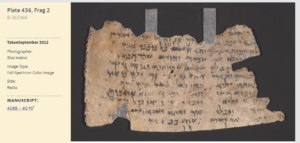
Psalms 22 fragment

One of the Nahal Hever scrolls surviving relatively intact is Psalms 22 where the potentially game-changing text uses the Hebrew word כארו (K’aru).[17] A translation of the Nehal Hever scroll from Psalms 22:14-18 translated by Dr. Martin Abegg Jr., Dr. Peter Flint and Eugene Ulrich reads:[18]

“[I have] been poured out [like water, and all] my bon[es are out of joint.  My heart has turned to wax; it has mel]ted away in my breast.  [My strength is dried up like a potsherd], and my tongue melts in [my mouth.  They] have placed [me] as the dust of death.  [For] dogs are [all around me]; a gang of evil[doers] encircles me.  They have pierced my hands and feet.  [I can count all my bones; people stare and gloat over me.  They divide my garments among themselves and they cast lots for my] clothes.” * [19]

Archeological discovery of the Nahal Hever scroll with its translation corroborate the much older Septuagint text translation of Psalms 22:16(17), both bearing the Hebrew word כארו (K’aru), “they have dug,” “pierced” or “pin.”

Do these two text discoveries strengthen the view that Psalms 22:14-18 is a foreshadowing or prophecy of the Messiah’s manner of death?  


Updated October 18, 2025.


* The words appearing in brackets were missing from the manuscript and have been supplied from other texts, if available.  The words appearing in italics are those that differ from the later Masoretic text.


Creative Commons License

This work is licensed under a Creative Commons Attribution-NonCommercial-NoDerivatives 4.0 International License.

REFERENCES:

[1] Davidson, Paul. “A Few Remarks on the Problem of Psalm 22:16.” Is That in the Bible?  2015. <https://isthatinthebible.wordpress.com/2015/09/28/a-few-remarks-on-the-problem-of-psalm-2216> “Psalm 22.”  Heart of Israel.  n.d.  <http://www.heartofisrael.net/chazak/articles/ps22.htm>  <http://web.archive.org/web/20171016070503/http://www.heartofisrael.net/chazak/articles/ps22.htm>   Barrett, Ruben.  “Bible Q&A:  Psalms 22.”  HaDavar Ministries.  27 May 2008.   Archived URL.  Archive.org.  23 Aug. 2012.   <http://web.archive.org/web/20120823025747/http://www.hadavar.net/articles/45-biblequestionsanswers/54-psalm22questions.html
[2] Hegg, Tim.  “Studies in the Biblical Text – Psalm 22:16 – “like a lion” or “they pierced”?” Torah Resource. 2013. <https://www.torahresource.com/EnglishArticles/Ps22.16.pdf>
[3] Fox, Tsivya. “Aleph, the First Hebrew Letter, Contains Depths of Godly Implications.” August 30, 2016. <https://www.breakingisraelnews.com/74824/adding-aleph-helps-bring-redemption> Benner, Jeff A. “Introduction to Ancient Hebrew.”  Ancient Hebrew Research Center.  2019. <https://www.ancient-hebrew.org/introduction.htm>  Benner, Jeff, The Ancient Hebrew Alphabet. 2019. <https://www.ancient-hebrew.org/introduction.htm>  Benner, Jeff A. “The Ancient Pictographic Alphabet.” Ancient Hebrew Research Center. 2019. <http://www.ancient-hebrew.org/6_02.html>  Benner, Jeff A. “Parent Roots of Hebrew Words.” Ancient Hebrew Research Center. 2019. <https://www.ancient-hebrew.org/introduction.htm>  Benner, Jeff A. “Anatomy of Hebrew Words.” Ancient Hebrew Research Center. 2019. <http://www.ancient-hebrew.org/vocabulary_anatomy.html> “Punctuation.” Jewish Encyclopedia. 2011. <http://www.jewishencyclopedia.com/articles/12441-punctuation>  Miller, Fred P. Moellerhaus Publishers. “Pluses and Minuses Caused by a Different Vorlage.” n.d. <http://www.moellerhaus.com/vorlage.html>
[4] The Babylonian Talmud. Rodkinson.  Book 4: Tracts Pesachim, Yomah and Hagiga, Chapter V.  Psalms 22 Hebrew Text fragment. BibleHumanities.org. image. 2012.http://bhebrew.biblicalhumanities.org/viewtopic.php?t=22288>
[5] “Psalms 22.” The Compete Jewish Bible – with Rashi Commentary. <https://www.chabad.org/library/bible_cdo/aid/16243>  “TEHILIM (Book of Psalms) Chapter 22.” Jewish Publication Society (JPS) translation. 1917. <http://www.breslov.com/bible/Psalms22.htm#17>  “Psalms 22.” Sefaria. <https://www.sefaria.org/Psalms.22?lang=bi>
[6] Bible Hub. “Psalms 22.” 2018. <https://biblehub.com/psalms/22-1.htm>  Bible.org. “Psalms 22.” 2019. <http://classic.net.bible.org/bible.php?book=Psa&chapter=22>
[7] “Psalm 22.”  MessianicArt.com. 2004.<http://web.archive.org/web/20120627010236/http://messianicart.com/chazak/yeshua/psalm22.htm>  “Psalms 22 Questions and Comments.”  JewishRoots.net. 2014. <http://jewishroots.net/library/prophecy/psalms/psalm-22/psalm-22-comments-from-hadavar-ministries.html> “”They pierced my hands and my feet” or “Like a lion my hands and my feet” in Psalm 22:16?” KJV Today. n.d. http://kjvtoday.com/home/they-pierced-my-hands-and-my-feet-or-like-a-lion-my-hands-and-my-feet-in-psalm-2216> Delitzsch, Franz. The Psalms.1880. pp 42-43, 317-320.<http://archive.org/stream/commentarypsalm01deliuoft#page/n9/mode/2up>  Benner, Jeff A. “Psalm 22:17 – “Like a lion” or “they pierced?”.” 2018. <https://www.patreon.com/posts/psalm-22-17-like-22030018>
[8] Josephus, Flavius. Antiquities of the Jews. Book XII, Chapter II.1-6. Trans. and commentary William Whitson. The Complete Works of Josephus. 1850. <http://books.google.com/books?id=e0dAAAAAMAAJ&printsec=frontcover&source=gbs_ge_summary_r&cad=0#v=onepage&q&f=false>   “The Septuagint (LXX).” Ecclesiastic Commonwealth Community. n.d. <http://ecclesia.org/truth/septuagint.html>   “Septuagint.”  Septuagint.Net. 2018.  <http://septuagint.net>  “Septuagint.” Encyclopædia Britannica. 2019. <https://www.britannica.com/topic/Septuagint>
[9] Lundberg, Marilyn J. “The Leningrad Codex.” USC West Semitic Research Project. 2012. University of Southern California. 8 Jan. 1999. <https://web.archive.org/web/20170403025034/http://www.usc.edu/dept/LAS/wsrp/educational_site/biblical_manuscripts/LeningradCodex.shtml> Abegg, Jr., Martin G., Flint, Peter W. and Ulrich Eugene Charles.  The Dead Sea Scrolls Bible:  the oldest known Bible translated for the first time into English. “Introduction”, page x. (page hidden by Google Books). 2002. <https://books.google.com/books?id=c4R9c7wAurQC&lpg=PP1&ots=fQpCpzCdb5&dq=Abegg%2C%20Flint%20and%20Ulrich2C%20The%20Dead%20Dead%20Sea%20Scrolls%20Bible%2C&pg=PP1#v=onepage&q=Isaiah&f=false>  Aronson, Ya’akov.  “Mikraot Gedolot haKeter–Biblia Rabbinica: Behind the scenes with the project team.”  Association Jewish Libraries. Bar Ilan University. Ramat Gan, Israel. n.d. No longer available free online – available for purchase:  <http://www.biupress.co.il/website_en/index.asp?category=12&id=714>
[10] Ben-David, Lenny. “Aleppo, Syria 100 Years Ago – and Today.” 23/07/15. Arutz Sheva 7 | isralenationalnews.com.  <http://www.israelnationalnews.com/News/News.aspx/198521> Ofer, Yosef. “The Aleppo Codex.” n.d. <http://www.aleppocodex.org/links/6.html>  Bergman, Ronen. “A High Holy Whodunit.” New York Times Magazine. July 25, 2012. <https://www.nytimes.com/2012/07/29/magazine/the-aleppo-codex-mystery.html>
[11] Leviant, Curt. Jewish Virtual Library. 2019. “Jewish Holy Scriptures: The Leningrad Codex.” <https://www.jewishvirtuallibrary.org/the-leningrad-codex>  “Leningrad Codex.” Bible Manuscript Society. 2019. <https://biblemanuscriptsociety.com/Bible-resources/Bible-manuscripts/Leningrad-Codex>
[12] Cohen, Menachem. “The Idea of the Sanctity of the Biblical Text and the Science of Textual Criticism.” Eds. Uriel Simon and Isaac B Gottlieb. 1979. Australian National University. College of Engineering & Computer Science. <http://cs.anu.edu.au/%7Ebdm/dilugim/CohenArt>  Miller, Fred P. Moellerhaus Publishers. “Pluses and Minuses Caused by a Different Vorlage.” n.d. <http://www.moellerhaus.com/vorlage.html
[13] “Siege of Jerusalem.” Encyclopædia Britannica. 2019. <https://www.britannica.com/event/Siege-of-Jerusalem-70>
[15] “Shimon Bar-Kokhba (c. 15 – 135).” Jewish Virtual Library. 2019. <https://www.jewishvirtuallibrary.org/shimon-bar-kokhba> “Bar Kochba.” Livius.org. Ed. Jona Lendering. 2019.< https://www.livius.org/articles/concept/roman-jewish-wars/roman-jewish-wars-8/>
[16] “Psalm 22.”  Heart of Israel.
[17] Hegg. “Studies in the Biblical Text – Psalm 22:16 – “like a lion” or “they pierced”?”
[18] Abegg, et. al. The Dead Sea Scrolls Bible. p xiv (hidden by Google Books).
[19] Abegg, et. al. The Dead Sea Scrolls Bible. p 518. (hidden by Google Books).
The Bewilderment of Mary Magdalene


Women of Galilee ran from the empty tomb terrified by their angelic encounter – Gospel authors collectively identified them as Mary Magdalene, Joanna, Mary the mother of James, Salome and “the other women.” Breathlessly arriving at the location of two of the mourning disciples, Peter and John, Mary Magdalene blurted out:[1]

JN 20:2 “They have taken the Lord from the tomb, and we don’t know where they have put him!” (NIV, NET)

A credible eyewitness statement, as opposed to an investigative report, is expected to begin at the point when the witness becomes personally involved in the sequence of events. The author of the Gospel of John’s personal involvement that Sunday morning began when the women burst into the room with their frantic news.

John and Peter were confused by Mary Magdalene’s excited statement. Faced with the group of excited women saying the body of Jesus had been taken was… dumbfounding.

LK 24:11 “But these words appeared to them as nonsense, and they would not believe them.”(NASB)[2]

Secured in a tomb behind a large stone held the mutilated, decomposing body of Jesus, tightly bound in linens with 75 pounds of spices – who would want it? Romans certainly didn’t want a body from a crucifixion which they typically discarded unburied, according to Josephus.[3]

Undoubtedly Jewish leadership didn’t want to lend any credence to a Resurrection especially since Jesus predicted he would rise from the dead after 3 days. Such a claim would be even worse, they told Pilate.

Maybe John and Peter knew of the armed Roman-Jewish koustodia guarding the sealed tomb, too. Additionally, a body snatching would have broken several Jewish Laws with at least a 7-day defilement consequence and no legitimate Jew wanted this.[4]

Mary’s blurted statement uses the Greek word airo meaning “to lift up,” translated into English as “have taken” in the context of the body had been taken by someone.[5] It conflicts with the actual angelic message in the accounts of Matthew, Mark and Luke who used the Greek word egeiro translated into English as “has been raised,” “has risen” or “is risen”: [6]

MT 28:6 “He is not here; for he has been raised [egeiro]”(NET, NLT, NRSV)

MK 16:6 “He has risen [egeiro]; He is not here.”(NASB, NIV)

LK 24:6 “He is not here, but is risen! [egeiro]”(NKJV)

Mary Magdalene did not relay the same message the angels had given to the women! Compounding the Disciples’ confusion, use of the plural pronoun “we” indicates she was not alone in this thinking – the other women with her did not dispute Mary’s assessment when she said “they have taken” his body.

How did the message get twisted? Mary Magdalene’s exclamation indicates her state of mind trying to reconcile what she had just experienced at the tomb with what she knew to be true – Jesus was dead, his body was missing and she didn’t know where it was.

Two Greek words, egeiro and airo, have similar meanings; the first being the movement action of a person and the second being the movement action of an inanimate object. Distinctions can be seen when both words were actually used together in a sentence by Jesus after he had performed one of his miracles. His words were reported by three different authors:

MT 9:6 “…He said to the paralytic, “Arise [egeiro], take up [airo] your bed, and go to your house.””(NKJV)

MK 2:11 “”I say to you, arise [egeiro], take up [airo] your bed, and go to your house.””(NKJV)

JN 5:8 “Jesus said to him, “Rise [egeiro], take up [airo] your bed and walk.””(NKJV)

Miraculously healed, the paralytic – the person – was commanded to rise [egeiro] on his own power without assistance and take up [airo] his bed, an inanimate object. Applying these word usage definitions to the two scenarios brings clarity to the contexts.

At the tomb, the angels’ message said Jesus had risen [egeiro] under his own power without any assistance – not possible for a dead man to do. In Mary Magdalene’s exclamation, she thought the inanimate body of Jesus had been “take[n] up” [airo] in the context of being “picked up” by a person or persons unknown and taken away.

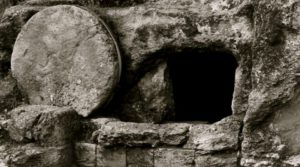
Tomb – Israel

Mentally processing their thoughts, suddenly a light bulb moment struck Peter and John at about the same time.[7] They raced to the tomb, John arriving first but paused while Peter charged straight inside.[8]

Still distraught over the death of Jesus and his missing body, Mary Magdalene followed John and Peter to the empty tomb.[9] Containing only the burial linens, the two Disciples marveled at what they had seen, then went back home leaving Mary behind weeping and trying to make sense of what had happened.

Looking back inside the empty tomb, Mary Magdalene once again saw two angels who were seated on each end of the place where the body of Jesus had lain. She had witnessed this earlier as it was prepared with burial spices by Joseph of Arimathea and Nicodemus.[10]

In her second angelic encounter that morning, this time Mary spoke to the angels who seemed perplexed as to why she was distraught asking her, “Woman, why are you weeping?”[11] She reiterated to the angels her missing body observation by repeating what she had told to Peter and John still using the word airo:

JN 20:13 “They have taken [airo] my Lord away, and I do not know where they have put him!”(NET, NIV)

Use of “they” rather than “you” in both of Mary’s statement suggests she believed these other persons who took away the body of Jesus were not present. By using the singular personal pronoun “I,” she is now speaking only for herself, not the other women.

Another voice asked Mary why she was crying. Maybe, she thought, he might be the person responsible for carrying away (bastazo – to lift up) the body of Jesus. Believing this new voice to be the gardener of the tombs, her demeanor and response intensified directly asking:[12]

JN 20:15 “”Sir, if You have carried (bastazo) Him away, tell me where You have laid Him, and I will take (airo) Him away.””(NJKV))[13]

“Mary!” – he called her by name. Not expecting this stranger to know her name and saying it in a familiar way that she immediately recognized, it snapped her to attention.

Clearly seeing Jesus, Mary cried out, “Rabboni!” meaning “my master, my teacher.”[14] Her excited utterance indicates a before and after death recognition of Jesus of Nazareth.

Overwhelmed with joy, Mary wanted to hug Jesus, but he told her to wait because he had not yet ascended “to My Father.”[15] Did Mary believe she was speaking to the same personage of Jesus whom she had known before he was crucified and buried?


Updated May 27, 2024.

Creative Commons License

Creative Commons Attribution-NonCommercial-NoDerivatives 4.0 International License.

REFERENCES:

NET = NET Bible translation; NASB = New American Standard Version; NIV = New International Version; NKJV = New King James Version translation; NLT = New Living Translation; NRSV = New Revised Standard Version.

[1] CR Matthew 28; Mark 16; Luke 24.
[2] CR Mark 16.
[3] Josephus, Flavius. Wars of the Jews. Trans. and commentary. William Whitson. The Complete Works of Josephus. 1850.  Book IV, Chapter V.2. <http://books.google.com/books?id=e0dAAAAAMAAJ&printsec=frontcover&source=gbs_ge_summary_r&cad=0#v=onepage&q&f=false>
[4] Exodus 23, 31; Leviticus 23, Numbers 19. Soncino Babylonian Talmud.  “Shabbath.” The Babylonian Talmud. Trans. Rodkinson. Book 1, Sabbath, Chapter I; Book 2, Tract Erubin; Book 3, Tract Pesachim, Book 3, Chapter IV.   “Shabbat” Jewish Encyclopedia. 2011. <http://jewishencyclopedia.com> “Festivals.” Jewish Encyclopedia.
[5] Net.bible.org. Greek text. Strong. “airo” <142The New Strong’s Exhaustive Concordance of the Bible.  <http://classic.net.bible.org/strong.php?id=142>
[6] Net.bible.org. Matthew 28:11. Greek text. “egeiro” <1453>” <http://classic.net.bible.org/strong.php?id=1453>
[7] Mark 9; Luke 18.
[8] Luke 24; John 20.
[9] John 20.  CR Luke 24. “Centuries later, archaeologists opened the tomb of Jesus.” News24hours. photo. 2016. <https://news24hours.in/2016/10/31/centuries-later-archaeologists-opened-the-tomb-of-jesus-christ
[10] Matthew 27; Mark 15; John 3, 7, 19.
[11] John 20.  NET.
[12] Net.bible.org. Greek text. “bastazo <941>.”  <http://classic.net.bible.org/strong.php?id=941>
[13] NKJV.
[14] John 20:16.   Net.bible.org. Greek text. NASB, NIV. “rhabboni <4462>” and “didaskalos <1320>.  CR Matthew 23:8.
[15] John 20. CR Matthew 28.

Are the Gospels in Sync with the Passover?


Interwoven throughout the Gospels are 21 references to the Passover by name and 6 references to either “the feast” or “the festival.” Skeptics make the charge that the Gospels contain Passover observance contradictions.[1]

Final days of Jesus of Nazareth took place during the annual Passover observance in Jerusalem. Circumstances surrounding the Passover in his case are the trial, execution and Resurrection.

Passover began when Moses defied Pharaoh in Egypt ending with the 10th plague, death of the firstborn.[2] Hebrews were spared when the angel of death passed over their homes bearing the blood of the sacrificial lambs over their doorposts.

God declared at Mount Sinai that this act of salvation was to be observed annually by the Hebrews to “sacrifice the Passover to the LORD your God” in the place where the LORD chooses to establish His name.”[3] Yet to be revealed was the location of the place.

At the onset of Nissan 15, the Feast of Unleavened Bread was to be eaten.[4] A key distinction, Jewish days begin at twilight just after sunset.[5]

Passover began at twilight of Nissan 14 just after the Pascal Lamb had been sacrificed earlier that afternoon. Strict requirements for the Passover appear in the books of the Law of Moses – Exodus, Leviticus, Numbers and Deuteronomy.[6]

Sunrise brought the initial daylight hours of the first day of Passover, Nissan 15, along with the daily necessities still to come. People were busy with required and traditional activities including meals and more sacrifices

Roasted lamb from the Pascal sacrifice became the main course of the Feast of Unleavened Bread.[7] The sacrifice meat was intended to feed 10 to 20 people for a festive and joyous occasion to celebrate God’s deliverance from bondage – freedom.

Jewish Talmudic law defined the sacrifices for each day including the meal plan for the first day of Passover. An entire tractate in the Babylonia Talmud entitled Chagigah is devoted to addressing the various expectations and requirements. Two “chagigah sacrifices” were associated with the Passover.[8]

As an optional festal offering, the first chagigah sacrifice was to be offered on Nissan 14 intended to supplement the Paschal sacrifice ensuring there would be enough meat to feed a large Passover company. It was equal to the paschal sacrifice itself and expected to provide for enjoyment of the festival.

Sacrificed first, there was to be no interruption with the Pascal Lamb sacrifice and the Feast of Unleavened Bread. Likewise, both had to be consumed by midnight with any leftovers from the meal to be burned.[9]

Called exactly that, the Chagigah, it had a different purpose and rules than the first optional chagigah sacrifice. It was an obligatory, private “peace offering” to be offered by an individual at the Temple with the assistance of a Priest who became a beneficiary to it.

A portion of this second chagigah sacrifice on Nisan 15 of Passover was to be given to God, a portion to the Priest as a tithe for his own meal, and the remaining portion of meat was to be taken home by the offerer for his own Chagigah meal. For this reason, a priest had a vested personal interest to assist in the sacrifice.

Meat from this second chagigah sacrifice was to be served as the main course before evening of the first day of Passover. The meal was to be consumed over the course of two days and one night – the first and second days of Passover, Nissan 15 and 16, and the night in between.

Things get interesting as it relates to the Gospels’ accounts describing the final hours in the life of Jesus of Nazareth, especially John 18:28. Two references are the cause of contention – the meal and the defilement.

JN 18:28 “They did not go into the governor’s residence so they would not be ceremonially defiled, but could eat the Passover meal.”(NET)

The Feast of Unleavened Bread had been eaten, Jesus was later arrested that evening and put on trial during the night. Early that same morning of Nisan 15, Jesus was taken by the Jewish leadership to Pilate at the Praetorium where the priests refused to go inside.

Entering the Praetorium was one of those things that could place a priest in a state of ritual defilement. When the author added “so they would not be defiled,” this could only be referring to the second Passover chigigiah meal since it was after the Feast of Unleavened Bread.

John does not explain the reason for the defilement. One possibility is the Jewish legal concept known as touching a dead body or home that once contained a dead body (the presumption was that it was common practice for mourning Romans to display a dead body in a building).[10]

After sunset, a ritualistic purification bath by the priest before the Feast of Unleavened Bread would have absolved this type of ritual defilement that may have occurred day on Nisan 14. In this case, however, it would be too late to absolve a ritual defilement.

A defiled priest on Nisan 15 could not perform any sacrifice that day. As a consequence, he would not receive his lawful portion of the chagigah sacrificial meat for his own meal.

Are the Gospel references to the Passover during the final days in the life of Jesus of Nazareth in agreement with Jewish Law defined in the Old Testament, the Tenakh, and the Talmud?


June 30, 2025.

Creative Commons License
This work is licensed under a Creative Commons Attribution-NonCommercial-NoDerivatives 4.0 International License.

REFERENCES:

[1] Wells, Steve. <u>The Skeptic’s Annotated Bible</u>. 2017. “423. When was Jesus crucified? <http://skepticsannotatedbible.com/contra/passover_meal.html>  “101 Bible Contradictions.” Islamic Awareness. n.d. Contradiction #69. <https://www.islamawareness.net/Christianity/bible_contra_101.html>  “Passover.” SVGmall.com. image. n.d. <https://svgmall.com/wp-content/uploads/2021/04/Passover-PNG-Free-Download.jpg?v=1619147248>
[2] Exodus 8-12. Roth, Don. “What year was the first Passover?” Biblical Calendar Proof. 2019. <http://www.biblicalcalendarproof.com/Timeline/PassoverDate>
[3] Deuteronomy 16. NASB.
[4] Exodus 12; Leviticus 23; Numbers 9; Deuteronomy 16. Edersheim, Alfred. The Temple – Its Ministry and Services. 1826-1889. “The Roasting of the Lamb.” pp 67 – 67, 75. <http://www.ntslibrary.com/PDF%20Books/The%20Temple%20
[5] Edersheim. The Temple – Its Ministry and Services. p 65.
[6] Exodus 12; Leviticus 23; Numbers 9; Deuteronomy 16. <http://www.ntslibrary.com/PDF%20Books/The%20Temple%20by%20Alfred%20Edersheim.pdf>
by%20Alfred%20Edersheim.pdf
>
[7] Deuteronomy 16. Edersheim, Alfred. The Temple – Its Ministry and Services. “The Roasting of the Lamb.” p 75.
[8] Talmud Bavli. Sefaria. Trans. William Davidson. n.d.  <https://www.sefaria.org/texts/Talmud>Edersheim. The Temple – Its Ministry and Services. “The Three Things.” pp 70-71.
[9] Gill. John Gill’s Exposition of the Whole Bible. John; chapters 18-19 commentary.  <https://www.studylight.org/commentaries/geb/john-18.html> Edersheim. The Temple – Its Ministry and Services. pp 70-71, 76, 79, 81-82.&nbsp; Josephus, Flavius. Wars of the Jews. Trans. and commentary William Whitson.  The Complete Works of Josephus.1850. Book VI, Chapter IX.3.  <https://books.google.com/books?id=e0dAAAAAMAAJ&printsec=frontcover&source=gbs_ge_summary_r&cad=0#v=onepage&q&f=false>  Edersheim, Alfred. The Life and Times of Jesus the Messiah. 1883. p 1324. <http://www.ntslibrary.com/PDF%20Books/The%20Life%20and%20Times%20of%20Jesus%20the%20Messiah.pdf>
[10] Leviticus 3, Numbers 19:13. Edersheim, Alfred. The Life and Times of Jesus the Messiah. 1883. Philologos Edition: Apr1301. n.d. <http://philologos.org/__eb-lat/default.htm> =The NTSLibrary. 2016. <http://www.ntslibrary.com/PDF%20Books/The%20Life%20and%20Times%20of%20Jesus%20the%20Messiah.pdf>. pp. 1334, 1352, 1394. Edersheim. The Temple – Its Ministry and Services. pp 70-71, 114. The Babylonian Talmud. Rodkinson. Tract Pesachim, Book 3, Chapter VI. <http://www.sacred-texts.com/jud/t03/psc09.htm> Edersheim, Alfred. The Life and Times of Jesus the Messiah. p 1324.  Gill. John Gill’s Exposition of the Whole Bible. John chapters 18 & 19 commentary.