Balaam’s Prophecy to a King
Mt. Sinai was past, but then the Hebrews spent 40 years of wandering through portions of the Sinai, Negev and Arabian deserts. Delayed by two generations as a consequence of the Hebrew’s lack of faith, a promise from God remained fully in effect: the Hebrew tribes would be protected from their enemies.[1]
Abraham, Isaac and Jacob had been promised through God’s blessings that many nations and kings would come from their descendants. Jacob divided the blessing among his sons, future fathers of the 12 tribes of Israel.
While promises made at Mt Sinai laid foundational requirements for the Messiah at the place, no particular prophecy pointed directly to the future Messiah. First of the distinctive Messiah prophecies came from a very unlikely source…
Following pillars of cloud by day and fire by night, the Hebrews were on their trek to the place.[2] Standing in the way of the Hebrews was yet another Gentile enemy, Moab, located east of the Dead Sea in modern day Jordan, ruled by King Balak son of King Zippor.
Balak was painfully aware of how the Hebrews had vanquished the strongly defensed Amorites whose own army had previously defeated Moab and occupied many of its cities. History was poised to repeat itself for Moab, this time at the hands of the Hebrews.[3]
Dread spread throughout Moab for fear of the size and might of the Hebrew people backed by God. Knowing his military was no match for the Hebrews, the King thought that only supernatural intervention from God could save his kingdom.
Rather than asking for God’s guidance and help, the King tried a different strategy; instead, he decided to try to place a curse on the Hebrews. Balak and sent an envoy of Moabite leaders to buy the services of Balaam for that purpose.[4]
Balaam was neither a Hebrew prophet nor even familiar with them. In real time, the encounter between Balak and Balaam was unknown to the Hebrews.
Finding Balaam, an envoy presented the King’s royal request and asked him to take a night to consider it. Praying for guidance that night, God told Balaam not to return to the Balak and not to place a curse on the Hebrews because they were “blessed.”
Following the response from God, Balaam rejected the offer. Returning home, the Moabite envoy informed the King the prophet refused to return with them although it is not stated if Balak was told why Balaam declined his offer.
Undeterred, Balak upped the ante by sending back to the prophet a larger envoy with more distinguished leaders promising Balaan great honors if he would return with them to place a curse on the Hebrews. Balaam told the second envoy that even if he was offered a palace full of silver and gold, he could not do more or less than God’s commandment.
Still, Balaam said he would give the envoy an answer the next morning and that night he again sought God’s guidance. Against God’s instruction, the next day Balaam decided to go with the envoy and meet the King, but their journey was blocked by an angel using a donkey to convey the message.
Balaam became angry with the donkey not moving and, not knowing an angel was blocking its way, beat the donkey and confronted Balaam about it. Confessing he had sinned, Balaam was allowed to continue with God’s strict instructions to say only what He was instructed.
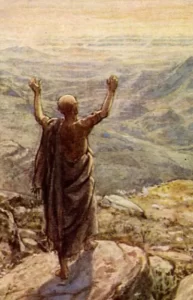 Upon arriving King Balak, who was irritated with Balaam, questioned why the prophet had resisted royal requests to come see him. Brushing off the question and getting right to the point, Balaam said,
Num 22:38 “I have come to you now, but do I have power to say just anything? The word God puts in my mouth, that is what I must say.”(NRSV)
Nevertheless, three times Balak took Balaam to a different high position on a mount to observe portions of the extensive size of the Hebrew people who could not be seen entirely from one location. On each mount, Balak offered a sacrifice.
After each sacrifice, the King asked the prophet to place a curse on the Hebrews. Each time, Balaam sought God’s message which came back with blessings on the Hebrews rather than a curse.
After the third time, Balak was exasperated. Clapping his hands King Balak said, “I called you to curse my enemies, but behold, you have persisted in blessing them these three times!”[5]
Announcing he was going back home, Balaam said he would foretell Moab’s future before he left.[6] It was a dark prophecy for Moab in the form of an oracle prefaced with a royal prophecy about Israel’s bright future:
Num 24:17 “I see him, but not now; I behold him, but not near; A star shall come forth from Jacob, A scepter shall rise from Israel, And shall crush through the forehead of Moab, And tear down all the sons of Sheth.”(NASB)
According to the renowned Jewish sage, Rabbi Rashi, Balaam’s oracle is a Messiah prophecy. Interpretations by the Rabbi are tied to the blessing of Jacob’s grandfather Abraham promising “kings will come forth from you.”[7]
“Scepter” is translated in the Bible from the Hebrew word shebet, the same word used in Jacob’s royalty blessing of his son, Judah, in Genesis 49:10. Rashi interpreted the term scepter as representing “a king who rules dominantly” from the future lineage of David.
Referring to the star, Rashi expounded it represents one who “shoots out like an arrow” from Jacob and uproots the sons of Sheth or Seth, the son of Adam; in other words, symbolically uproots all of mankind.[8]
If the appearance of Jesus of Nazareth was to be a fulfillment of Balaam’s prophecy, a lot of pieces first had to come together to fulfill the promises made at Mt. Sinai. Hundreds of years into the future, prophets of the Bible would bring clarity to these promises that became requirements setting the stage for the Messiah to be born in the royal lineage of the House of David.
Promises made at Mt. Sinai were fulfilled over time, but one part of Balaam’s prophecy was not yet fulfilled – “A star shall come forth from Jacob.” Was it a symbolic prophecy of someone who would uproot all of mankind or was it a literal prophecy fulfilled by “his star” observed by the Magi signaling the birth of the “King of the Jews”… perhaps both?
Updated January 3, 2026.

This work is licensed under a Creative Commons Attribution-NonCommercial-NoDerivatives 4.0 International License.
REFERENCES:
[1] Deuteronomy 2-7; 23:23-31; Number 14:24, 26-35.
[2] Numbers 14. “Sinai Peninsula;” “Negev;” and “King’s Highway.” Encyclopædia Britannica. 2014. http://www.britannica.com
[3] Numbers 21-22. “Map of OldTestament Israel.” Bible-history.com. <http://www.bible-history.com/geography/ancient-israel/israel-old-testament.html> “Israel and Judah.” Free English Site. map. 2017. <http://www.freeenglishsite.com/LDS/other/Moab.htm>
[4] Numbers 22. CR Deuteronomy 23:5/6.
[5] NASB. Numbers 24:10. “What is the error of Balaam?” EndoftheMatter.com. image. 2022. <https://i0.wp.com/endofthematter.com/wp-content/uploads/2021/07/BalaamintheBible-171300653-43bf701fd28844c6a5682acf05b9c83a.jpg?fit=1024%2C576&ssl=1>
[6] Numbers 24:20-24.
[7] Gensis 17:6, NASB.
[8] Rashi. The Complete Jewish Bible with Rashi Commentary Commentary for Numbers 24:17.
