The Temple – Significance to the Trial of Jesus
Prosecution by Caiaphas during the overnight trial of Jesus of Nazareth was not going well because no two witnesses could agree on the same accusation as required by Jewish law.[1] Finally two witnesses presented the same accusation:
MK 14:58 “”We heard Him say, ‘I will destroy this temple made with hands, and in three days I will build another made without hands.’”” (NASB)[2]
Not quite the same according to the Gospel accounts of Mark and John.[3] Jesus actually said, “Destroy this temple, and in three days I will raise it up.”[4]
No legitimate Jew would ever think of destroying the Temple – it was the sacred House of God. Rebuilding the Temple in 3 days was a feat that only God could do and became the foundation to the charge of blasphemy.
Hours later, the charge persisted at the crucifixion site of Jesus suggesting the mockers had been at the trial. The taunters asked Jesus that if he could destroy and rebuild the Temple in 3 days, why he could not he save himself from the cross?[5]
. . . . .
History of the Temple began at Mt. Sinai with Moses. Atop Mt. Sinai, God not only gave Moses the Law, He also made five big promises to the Hebrews all tied to the place.
Three of those promises – the permanent dwelling place for His Name; the place to observe the three annual pilgrim feasts; and the judgment seat of Israel – all specifically involved the future Temple.[6]
Until promises of the place came to fruition, instructions were given to the Hebrews for a temporary mobile structure for the place for God’s Name to dwell, a tent called the Tabernacle.[7] God’s design for the Tabernacle served as a type of blueprint for the future Temple, its usage and contents.[8]
Centuries later, King David told God he wanted to build the permanent House of God, but God had other plans. Prophet Nathan delivered the message that David’s future son would fulfill the promise given to Moses to build the Temple.[9]
Later, the King wanted to atone for his sin for lacking faith in God that resulted in the deaths of thousands of Hebrews. David found Jebusite Araunah’s threshing floor on high ground as a suitable place for this sacrifice.[10]
Araunah’s threshing floor was located on Mt. Moriah, the same place when, a thousand years earlier, Abraham took his only son, Isaac, to be sacrificed and was then spared at the last moment. The Scriptures do not say whether David knew this.[11]
Using his own money, the King bought the threshing floor along with all its equipment to use as the fuel for the sacrifice.[12] David prepared the offering building an altar himself, .
Fire came down from Heaven and consumed the sacrifice on the altar. Moved deeply, David declared “This is the house of the LORD God, and this is the altar of burnt offerings for Israel.”[13]
Temple construction began in the fourth year of King Solomon’s reign and was completed seven years later.[14] Solomon held a public consecration for the permanent dwelling place for the Name of God and prepared a sacrifice on the altar in front of the new Temple declaring:[15]
2 CH 6:2-11 “I have surely built You an exalted house, and a place for You to dwell in forever.”(NKJV)
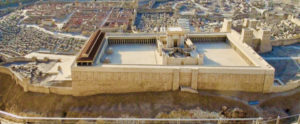
During the night, God appeared to Solomon reminding the King that although He had fulfilled His promises from Mt. Sinai, it was not carte blanche – it came with a stipulation:[18]
2 CH 7:19-20 “But if you turn away and forsake My statutes and My commandments which I have set before you, and go and serve other gods, and worship them, then I will uproot them from My land which I have given them; and this house which I have sanctified for My name I will cast out of My sight, and will make it a proverb and a byword among all peoples.” (NKJV)
After centuries of ignoring warnings from many prophets, the penalty stipulation was enacted – the army of King Nebuchadnezzar destroyed Jerusalem and the Temple. Seventy years later the captivity in Babylon ended and the Second Temple was rebuilt under the decree of Persian King Cyrus with continued support from Kings Darius and Artaxerxes.[19]
King Herod enhanced the Second Temple, though primarily for his own personal ambitions, was able to sell the idea to the Jewish leadership saying he wanted to bring the Temple back to the intended grandeur of King Solomon which had been unaffordable at the time it was rebuilt.[20] The enhanced Second Temple, also called Herod’s Temple by many, became the location of the trial Jesus of Nazareth.[21]
. . . . .
Caiaphas asked Jesus during the trial in the Temple if the accusation was true, but received no answer. As the High Priest, he had to be aware of Zechariah’s prophecy foretelling the Branch would build the Temple:
Zech 6:12-13 “…Behold, the Man whose name is the BRANCH! From His place He shall branch out, And He shall build the temple of the LORD; Yes, He shall build the temple of the LORD. He shall bear the glory, And shall sit and rule on His throne; So He shall be a priest on His throne, And the counsel of peace shall be between them both.” (NKJV)
Knowing the magnitude of the accusation was evidenced by the next direct question by the prosecutor. Cutting straight to the heart of the trial Caiaphas pointedly asked Jesus:
“Are you the Messiah, the Son of the Blessed One?”(ISV, NRSV)[22]
Jesus answered, “I Am,” serving as sufficient proof to Caiaphas that he had spoken a blasphemy. The High Priest and the Sanhedrin serving as jurors then took action to have Jesus put to death.[23]
Was the claim by Jesus that he would rebuild the Temple in 3 days a daring metaphoric prediction spoken by the Son of God or was it a delusional claim of a man saying he would physically destroy and rebuild the Temple in three days?
Updated December 21, 2025 .

This work is licensed under a Creative Commons Attribution-NonCommercial-NoDerivatives 4.0 International License.
REFERENCES:
[1] Deuteronomy 17:6, 19:15; Numbers 35:30. Soncino Babylonian Talmud. Ed. Isidore Epstein. Sanhedrin 9a, 30a. <https://israelect.com/Come-and-Hear/sanhedrin/index.html> Resnicoff, Steven H. “Criminal Confessions in Jewish Law.” Project Genesis. 2007. <http://www.jlaw.com/Commentary/crimconfess.html>
[2] CR Matthew 26:60-61.
[3] Mark 14:59, John 2:19-21.
[4] John 2:19-21. NASB.
[5] Mark 15:29.
[6] Deuteronomy 12:5, 11, 16:6; 17:8-10. CR Exodus 12:14-15; Leviticus 23:4-8. CR Deuteronomy 16:1-8; II Chronicles 8:12-14, chapter 29, 35:1-6.
[7] Exodus 25:8-9. Leviticus 9:126:11; Numbers 9:15; Deuteronomy 12:22, 16:2, 6, 26:2; 2 Chronicles 5:2-10; I Kings 8:10.
[8] 1 Kings 6. 2 Chronicles 5-6.
[9] 2 Samuel 7:12-17.
[10] “Threshing.” Encyclopedia.com. 2019. <https://www.encyclopedia.com/plants-and-animals/agriculture-and-horticulture/agriculture-general/threshing> “Agriculture.” Jewish Encyclopedia. 2011. <http://www.jewishencyclopedia.com/articles/14378-thrashing-floor
[11] 2 Chronicles 3:1. CR Genesis 22. Josephus. Antiquities. Book I, Chapter III.
[12] I Chronicles 21:18-26; 2 Samuel 24:18-25. Josephus, Flavius. Antiquities of the Jews. Book VII, Chapter XIII.3. <https://books.google.com/books?id=e0dAAAAAMAAJ&printsec=frontcover&source=gbs_ge_summary_r&cad=0#v=onepage&q=Araunah&f=false> Dolphin, Lambert. “Mount Moriah, Site of the Temple Mount in Jerusalem.” TempleMount.org. 1996. <http://www.templemount.org/moriah2.html>
[13] I Chronicles 22:1. NKJV.
[14] 1 Kings 6:1, 37-38. CR 2 Chronicles 3:1-2.
[15] 2 Chronicles 6:1-7.
[16] “The Temple.” The Victor’s Place. photo. Feb. 2. ? <https://images.search.yahoo.com/yhs/search;_ylt=AwrCwOUslAdjzRoASQ0PxQt.;_ylu=Y29sbwNiZjEEcG9zAzEEdnRpZAMEc2VjA3BpdnM-?p=The+Temple%2C+Jerusalem&type=yhs-adk_sbnt_appfocus1_sm_ff¶m1=20210118¶m2=00000000-0000-0000-0000-000000000000¶m3=searchmanager_%7EUS%7Eappfocus1%7E¶m4=%7Efirefox%7E%7E&hsimp=yhs-adk_sbnt&hspart=adk&grd=1&ei=UTF-8&fr=yhs-adk-adk_sbnt#id=96&iurl=https%3A%2F%2Fvhoagland.files.wordpress.com%2F2021%2F02%2Fdsc00129.jpg&action=click>
[17] 2 Chronicles 7:1-3.
[18] 2 Chronicles 7:11-18.
[19] Ezekiel 1:2-3; 6:7,12; 7:12-13, 23, 26. “Building the Second Temple.” My Jewish Learning. 2019. <https://www.myjewishlearning.com/article/second-templer> Cohney, Shelley. The Jewish Temples: The Second Temple.” Jewish Virtual Library. 2019. <https://www.jewishvirtuallibrary.org/the-second-temple>
[20] “Herod the Great.” Livius.org. Ed. Jona Lendering. 2019. <https://www.livius.org/articles/person/herod-the-great> Josephus. Antiquities. Book XV, Chapter XI. Edersheim, Alfred. The Temple – Its Ministry and Services. 1826 -1889. Chapter 1. <http://www.ntslibrary.com/PDF%20Books/The%20Temple%20by%20Alfred%20Edersheim.pdf> Hegg, Tim. “Separating the Most Holy from the Holy: The ‘Veil’ in the Tabernacle and First & Second Temples” Torah Resource. <http://www.torahresource.com/EnglishArticles/Veil%20ETS%20Paper.pdf> Spiro Ken. “History Crash Course #31: Herod the Great.” Aish.com. 2001. <https://www.aish.com/jl/h/cc/48942446.html> “Rebuild Herod’s Temple? A Few Israelis Hope.” New York Times. April 9, 1989. <https://www.nytimes.com/1989/04/09/world/rebuild-herod-s-temple-a-few-israelis-hope.html>
[21] Numbers 11:16-17, 24. Ariel, Yisrael. “The Chamber of the Hewn Stone.” The Temple Institute. 2019. <https://www.templeinstitute.org/illustrated/hewn_stone_description.htm> Ariel. “Blueprints for the Holy Temple.” <http://www.templeinstitute.org/blueprints-for-the-holy-temple.htm>
[22]2] Mark 14:61.
[23] Matthew 26:62-66; Mark 14:612-65; Luke 22:70-71.
